
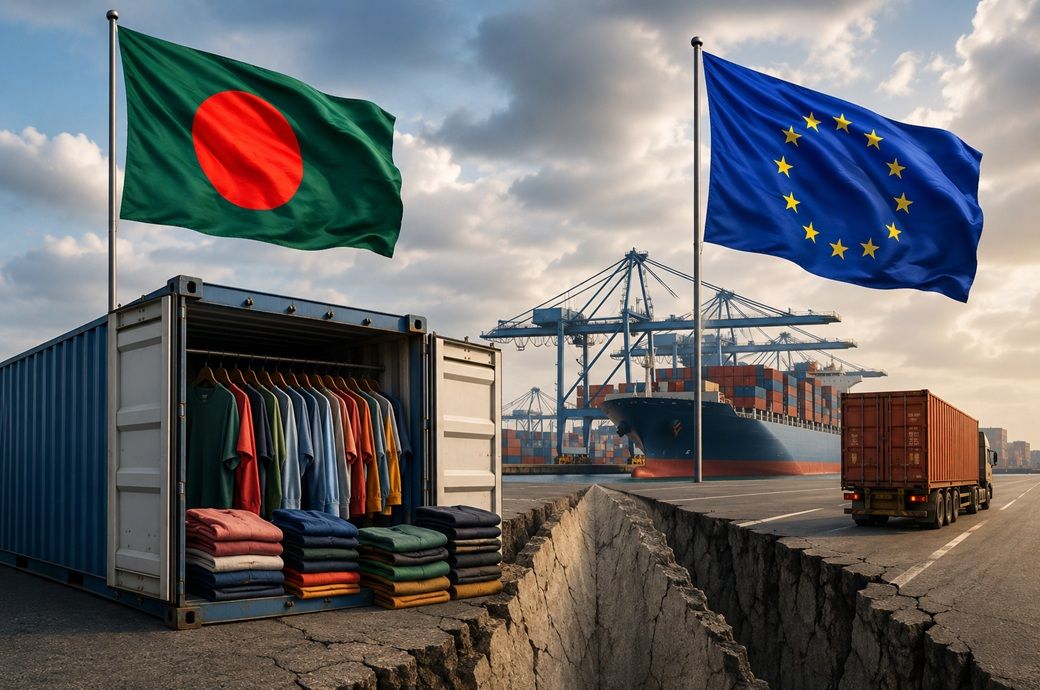
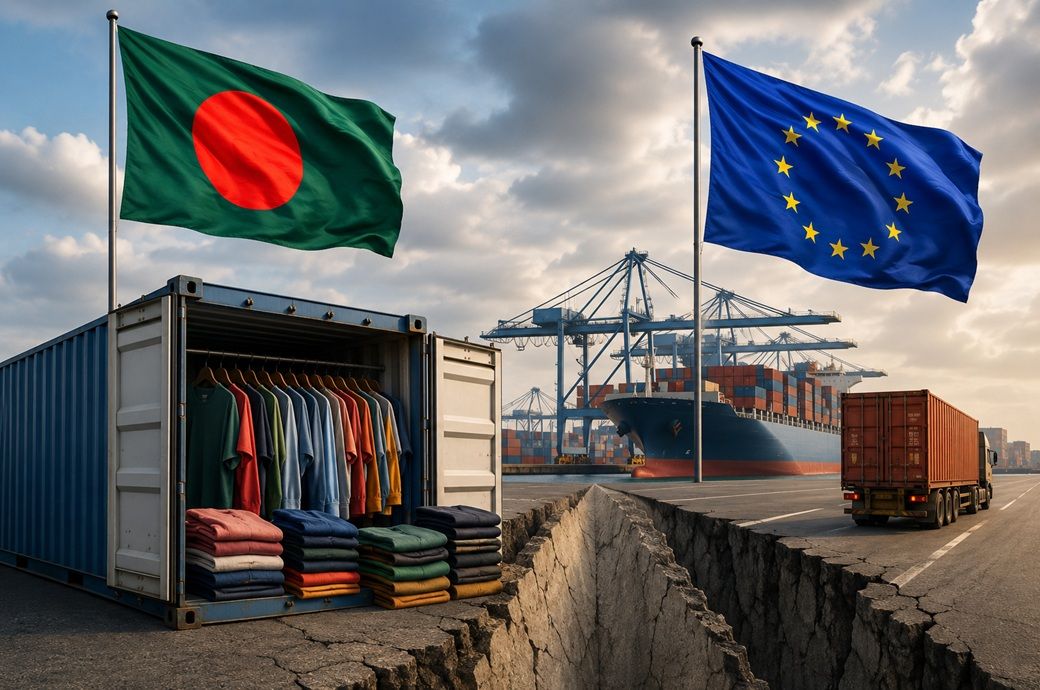
The decline was broad-based, but Bangladesh appears to have taken a bigger hit than many of its competitors.
Bangladesh’s apparel exports to the EU fell 16.43 per cent to €8.64 billion in January-June 2026, steepest amongst key suppliers.
EU apparel imports weakened, but lower unit prices kept Bangladesh’s higher volumes from raising value.
LDC graduation uncertainty, possible EU-India FTA gains, energy shortages and Chinese and Vietnamese marketing press suppliers on reliability and value addition.
Exports from China, Turkiye, India, Pakistan, Sri Lanka, and Cambodia to the EU also reportedly declined during the period. But Bangladesh reportedly recorded the steepest declines amongst the major suppliers, with Turkiye reportedly posting the next-largest decline at 14.60 per cent, followed by Pakistan at 12.53 per cent, India at 12.49 per cent, Sri Lanka at 11.21 per cent, and Cambodia at 8.84 per cent.
It may be mentioned here that Bangladesh was the bloc’s second-largest garment supplier in 2025.
Meanwhile, China, despite an 8.88 per cent decline in exports, as maintained by reports citing data from Eurostat, retained its position as the EU’s largest garment supplier by value. Interestingly, Bangladesh reportedly shipped a larger volume of garments than China during the period. But its lower unit price meant that the higher volume did not translate into higher export value.
Indonesia and Cambodia reportedly also increased their average unit prices.
Vietnam, meanwhile, managed to buck the broader downward trend. Its apparel exports to the EU reportedly edged up 0.36 per cent to €2.06 billion (~$2.4 billion), even though shipment volume fell 11.52 per cent.
A 13.43 per cent increase in average unit prices reportedly helped offset the decline in shipments.
Meanwhile, the EU’s overall apparel imports from the world reportedly fell 9.7 per cent year-on-year in the first half of 2026 to €41.1 billion (~$47.79 billion), reports claimed, citing the data. Import volumes declined 6.4 per cent, while average prices reportedly fell 3.53 per cent.
However, industry stakeholders in Bangladesh believe the numbers tell a story that goes beyond a simple slowdown in European consumption. As consumers cut back on apparel purchases, EU buyers may have reduced orders across sourcing destinations, but for Bangladesh, they felt, country-specific factors were also at work, even as they cited uncertainty over Bangladesh’s future preferential market access to the EU following its LDC graduation as a growing concern.
Industry players also pointed towards increasingly aggressive marketing efforts of China and Vietnam. With overall demand weakening and fewer orders up for grabs, the contest for every remaining piece of business has intensified. Chinese suppliers, in particular, they felt, were actively pursuing buyers and stepping up market outreach in the EU to capture more orders.
The EU-India Free Trade Agreement is also emerging as a longer-term competitive concern. Industry players are concerned that improved EU market access for Indian exporters could give them a competitive advantage over Bangladeshi suppliers.
They are also equally worried about persistent gas and power shortages at home as suppliers elsewhere fight harder for orders.
The ongoing energy crisis forced some buyers to partially relocate work orders from Bangladesh as factories struggled to maintain production and ensure timely shipment, an industry insider claimed.
Meanwhile, the Bangladesh Finance and Planning Minister recently reportedly underlined that problems surrounding gas and electricity could not be resolved within six months or a year and would require at least two years.
Taken together, these pressures suggest that the competitive environment could remain difficult for some time.
The challenge ahead, therefore, is no longer simply about keeping orders flowing. As competitors maintain or increase unit values, product mix, value addition, pricing power, and buyer positioning will matter increasingly. For Bangladesh, retaining buyers, improving production reliability, and moving towards higher-value apparel segments will thus be crucial to defend its position in the EU market.
Fibre2Fashion News Desk (DR)