

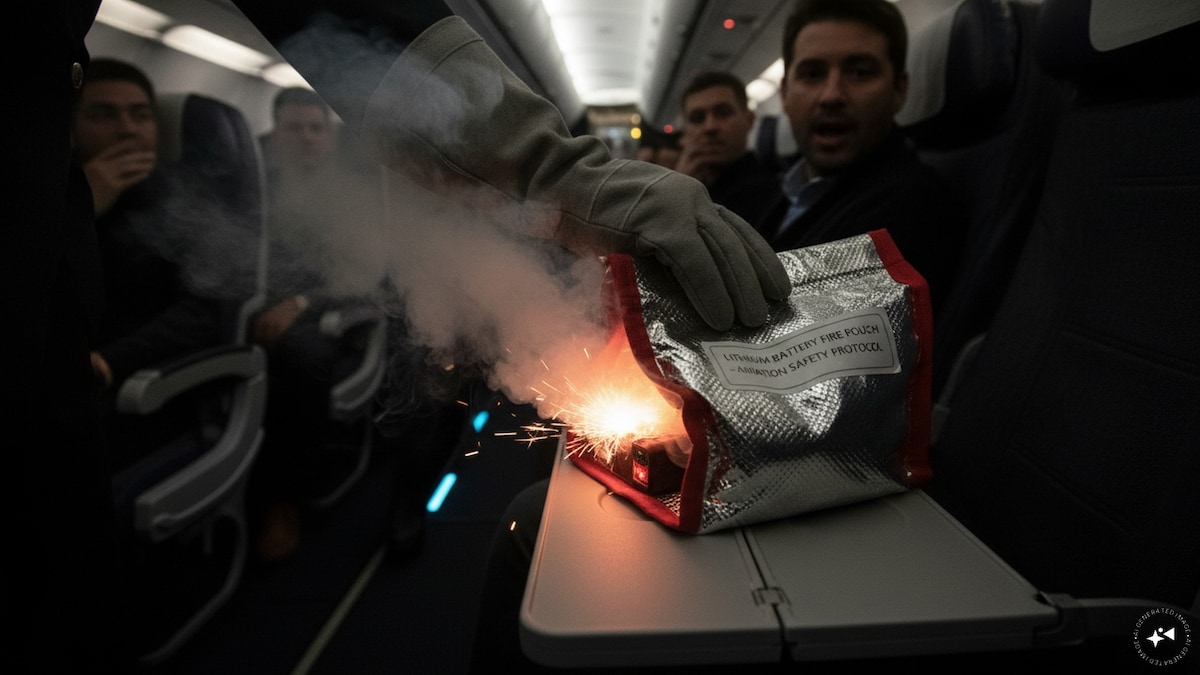
An IndiGo flight from Delhi to Chennai was diverted to Hyderabad on October 11 after a power bank kept in the overhead luggage compartment caught fire. The cabin crew used a fire extinguisher to put out the fire, and the plane landed safely in Hyderabad.
A 36-second video from inside the flight showed passengers trying to put out the fire using their bags. IndiGo said the crew responded quickly and an alternate aircraft had been arranged to take passengers to Chennai.
The incident has raised concerns about the risks of carrying power banks on flights.
Why do power banks catch fire?
Most power banks use lithium-ion batteries. These batteries can store a lot of energy in a small space. However, they can become dangerous if the battery gets too hot or develops a fault.
A power bank produces heat when it is charged or used to charge another device. Normally, this heat does not cause a problem. But if the battery gets too hot and cannot cool down, its temperature can rise very quickly, which is known as thermal runaway.
Pierre Kubiak, a principal engineer specialising in battery technology at the UK’s National Physical Laboratory, told BBC that the temperature during such fires can rise to more than 700 to 1,000 degrees very quickly.
He said the fire does not come from lithium alone. Other materials inside the battery, including chemicals and plastic parts, can also catch fire.
What causes a power bank to catch fire?
There can be several reasons why a power bank catches fire. These include poor-quality batteries, manufacturing defects, physical damage and improper use.
One of the reasons could be poor-quality batteries as some power banks use low-quality or poorly made battery cells. If these cells have defects, they may overheat and catch fire. Sagar Mitra, a professor at IIT Bombay, told Indian Express that manufacturing defects in low-quality battery cells could be one possible reason for such fires.
Another reason is the damage inside the battery. A battery has two terminals, positive and negative, which are meant to remain separate. If the protective layer between them gets damaged, the two sides may come into contact, which can cause a short circuit.
Also, leaving a power bank in direct sunlight or in a hot place can increase its temperature. If the battery is already damaged, the extra heat can make it more likely to catch fire.
Can a power bank catch fire when it is not being used?
Yes, a power bank does not have to be connected to a phone or charger to catch fire. If there is a fault inside its battery, it can overheat even when it is not being used. Physical damage and manufacturing defects can cause a short circuit inside the battery, which may lead to a fire.
Why are power banks a concern on flights?
A battery fire inside a plane can be particularly dangerous because it can produce a lot of heat and smoke in a closed space.
According to IndiGo’s website, “Power banks and spare/loose lithium batteries are permitted only in hand baggage. They must remain within the passenger’s personal reach at all times, such as under the seat, in the seat pocket, or carried on one’s person.”
In November 2025, the Directorate General of Civil Aviation (DGCA) issued an advisory prohibiting passengers from using or charging power banks during flights. It also said power banks should not be stored in overhead compartments because they may be difficult to reach quickly during an emergency.
Similar incidents
There have been several incidents of power banks catching fire on flights. The recent IndiGo incident is not an isolated case.
In June 2026, technology journalist Ben Wodecki witnessed such an incident on a flight arriving in Las Vegas. A passenger’s battery pack overheated and burst into flames, setting a seat on fire.
Last year in July, a passenger’s power bank began smoking during disembarkation from a Boeing 737 near Hobart, Australia.
Similarly, in March 2025, a Hong Kong Airlines Airbus A320 was diverted after a power bank experienced thermal runaway.
How can you carry a power bank safely?
Here are some simple precautions to follow when travelling by air:
Keep it in your cabin baggage.
Do not charge or use it during the flight.
Avoid damaged power banks.
Choose a reliable brand with clear information about battery capacity and safety.
Keep it away from heat
Use the right charger.
Power banks are useful when travelling, but a damaged or faulty battery can become a safety risk.