
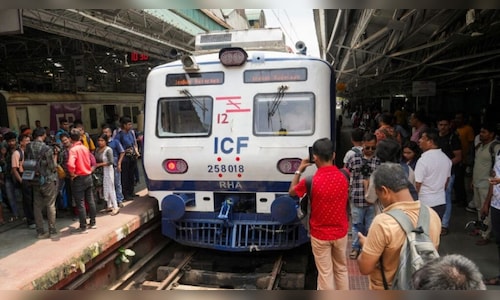
Mumbai Suburban is one of the busiest railway systems in the world. Spread across 376 route kilometres under Central and Western Railways, the system handles thousands of services daily but has also earned a grim reputation due to frequent accidents caused by commuters hanging onto open doors during peak hours. Between January 2014 and May 2025, nearly 6,760 deaths and 14,257 injuries were recorded in such incidents.
In June 2025, Mumbra tragedy, another such incident occurred where five commuters died after falling off overcrowded locals. Within hours of this incident, the Railway Board mandated automatic door systems for all new non-AC suburban rakes.
What’s inside the new train?
The train has 12 coaches with a total capacity of 5,698 passengers, 1,003 seated and 4,695 standing. It consists of eight second-class and four first-class coaches, with dedicated sections reserved for women and specially-abled passengers, along with 19 luggage compartments.
At the core of the design is an automatic door system intended to eliminate unsafe boarding practices. The doors are programmed to open in about 3 seconds and close in 4 seconds, with a fixed 30-second dwell time to station halts.
Interlocking mechanisms ensure the train cannot move unless all doors are shut, while obstruction detection and anti-drag features aim to prevent accidents during boarding and alighting.
“The non-AC EMU is a significant upgrade over conventional open-door EMUs. It will prevent unsafe boarding and alighting from moving trains. It will also reduce accidents caused by open doors, and bring discipline among passengers with controlled boarding of the train,” Indian Express quoted an ICF official as saying.
The ventilation challenge
The biggest hurdle in designing a closed-door non-AC train has been ventilation. Earlier trials showed a sharp rise in carbon dioxide levels inside sealed coaches. To overcome this, the new rake is equipped with two high-capacity blowers that supply 10,000 cubic metres of air per hour, roof-mounted ventilation units to pump in fresh air, larger windows, and louvred doors (the horizontal, angled slats allowing air circulation while maintaining privacy).
The coaches also have two-thirds openable windows to maintain airflow while keeping passengers secure.
Additional safety and comfort upgrades
In addition to safety enhancements, the train includes modern features such as fire detection systems, emergency talk-back units near doors, modified alarm mechanisms, passenger information displays, and improved seating layouts. Vestibule connections are also there to allow movement between coaches, while internal sliding doors provide backup exit routes in case of emergencies.
Is this the final prototype?
Before entering passenger service, the train will undergo mandatory trials and certification by the Research Designs and Standards Organisation, a process expected to take around three months. Officials said the rollout follows a directive from the Railway Board after the Mumbra tragedy in June 2025, where several commuters lost their lives after falling from overcrowded trains.
The prototype will also undergo multiple rounds of trials to ensure it does not compromise passenger comfort during different crowd conditions. The long-term vision for Mumbai’s suburban network includes a transition to fully air-conditioned services under the Mumbai Urban Transport Project (MUTP)-III and IIIA.
The Railways has sanctioned 238 AC rakes of 12 cars at a cost of ₹ 19,293 crore, with hundreds of new AC rakes planned for induction by 2028.
Alongside rolling stock upgrades, Indian Railways is also investing in infrastructure improvements such as platform extensions, additional tracks, and station redevelopment to enhance overall capacity and commuter experience across the network.
As of now, Western Railway operates 1,414 services, including 133 AC services, while Central Railway operates 1,820 services, including 94 AC services serving passengers across Mumbai, Thane, Kalyan, Virar, and Panvel.