
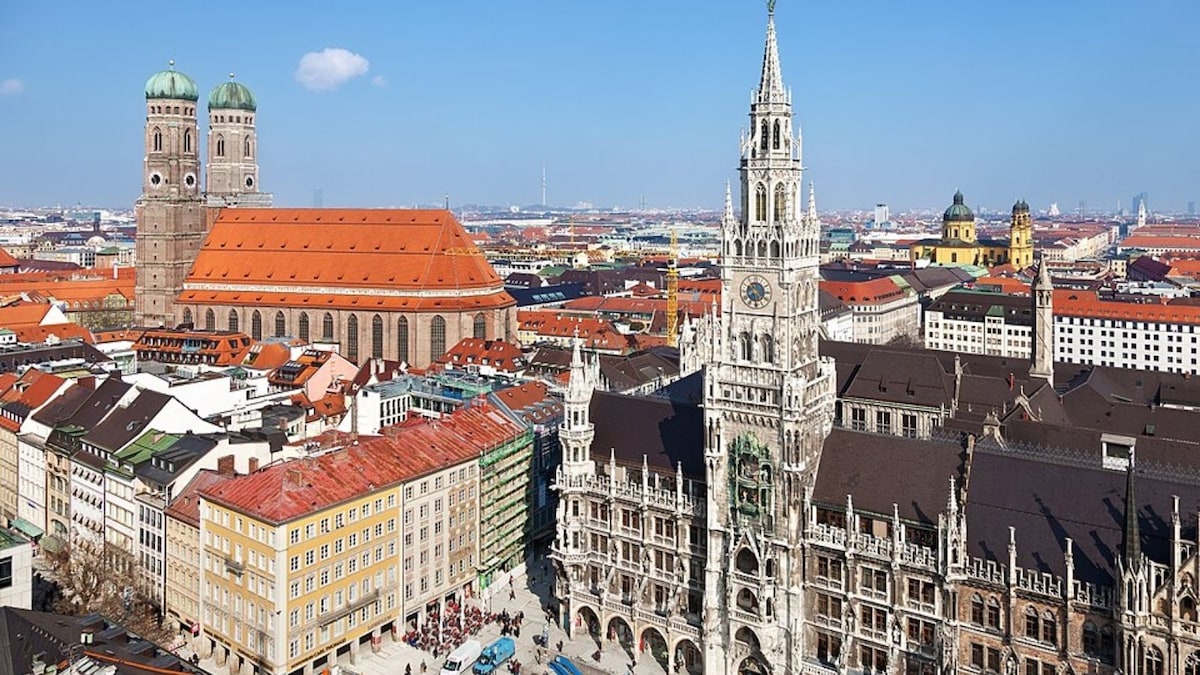
But Munich is far more than a backdrop to a fortnight of festivities. It is an architectural marvel steeped in royal history, lined with leafy urban sanctuaries and alive with world-class design. To balance the spirited chaos of Theresienwiese, here is where to look when you are ready to explore the city’s rich cultural tapestry.
There is no better starting point than Marienplatz or Mary’s Square, the historic square at the heart of the Altstadt. Framed by the soaring neo-Gothic façade of the Neues Rathaus (New Town Hall), the square fills several times a day as visitors crane their necks to watch the famous Glockenspiel spring into life. Forty-three bells and 32 life-sized figures re-enact centuries-old Bavarian tournaments and wedding lore, offering a charming glimpse into local folklore. For a vantage point that surpasses the crowded square below, climb the winding stairs of St Peter’s Church tower. The panorama from the summit reveals the twin onion-domed silhouettes of the Frauenkirche (Cathedral of Our Dear Lady) against a skyline that, on crisp autumn afternoons, stretches all the way to the Alps.
A short walk away lies the sensory antidote to festival fast food: the bustling open-air Viktualienmarkt (Food Market). Serving locals since the early 19th century, this lively market square hums with more than 100 boutique stalls laden with freshly baked pretzels, artisanal cheeses, pickled vegetables and seasonal produce. Beneath a towering blue-and-white Bavarian maypole, the market’s communal beer garden rotates taps among Munich’s six traditional breweries, offering a tranquil spot to enjoy a drink alongside locals reading the morning paper.
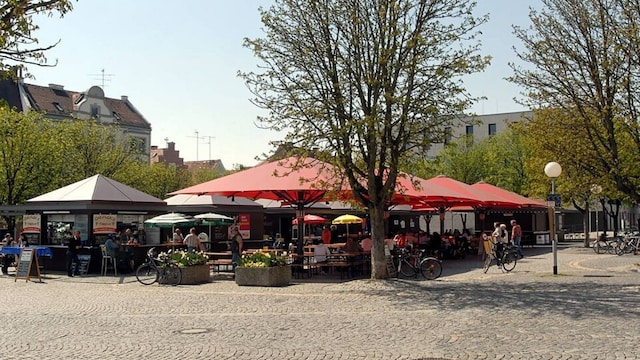
Image source: Wikimedia Commons
Stretching north from the city centre along the grand neoclassical Ludwigstraße (Ludwig Street) stands one of Munich’s most striking monuments: the Siegestor (Victory Gate). Modelled after Rome’s Arch of Constantine by King Ludwig I and crowned by a bronze statue of Bavaria with four lions, this three-arched triumphal gate was heavily damaged during World War II. Its restored southern facade bears a moving inscription that serves as a modern civic reminder: “Dem Sieg geweiht, vom Krieg zerstört, zum Frieden mahnend”—Dedicated to victory, destroyed by war, urging peace. Passing through the gate brings you straight into Schwabing, Munich’s bohemian university quarter, filled with leafy avenues, buzzing sidewalk cafes, and distinctive Art Nouveau architecture.
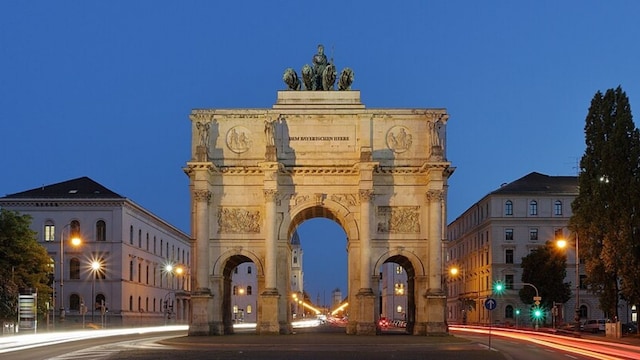
Image source: Wikimedia Commons
When festival fatigue sets in, the neighbouring Englischer Garten offers a green escape that rivals any major metropolitan park in the world. Larger in footprint than New York’s Central Park, this sweeping expanse unfolds through leafy meadows, shaded woodland trails, and waterways fed by the nearby Isar River. At its southern border, near the Haus der Kunst (House of Art), lies the Eisbachwelle (Eisbach Wave). Come rain or autumn chill, spectators lean over the stone bridge to marvel at wetsuit-clad river surfers carving up a ferocious, perpetual standing wave on the chilly waters. Further into the gardens, winding footpaths lead to the historic Chinesischer Turm (Chinese Tower), where an ornate wooden pagoda rises above tables shaded by golden chestnut canopies.
To truly appreciate the dynastic wealth that gave rise to Oktoberfest, make the short journey west to Schloss Nymphenburg (Nymphenburg Palace). Once the sprawling summer retreat of Bavarian rulers, this grand Baroque estate dazzles with sweeping canals, mirrored halls, and the portrait-filled Gallery of Beauties commissioned by King Ludwig I. The manicured palace grounds invite long, quiet strolls through baroque landscaping and secluded pavilion hideaways, offering a serene counterpoint to the city’s festive brass instruments.
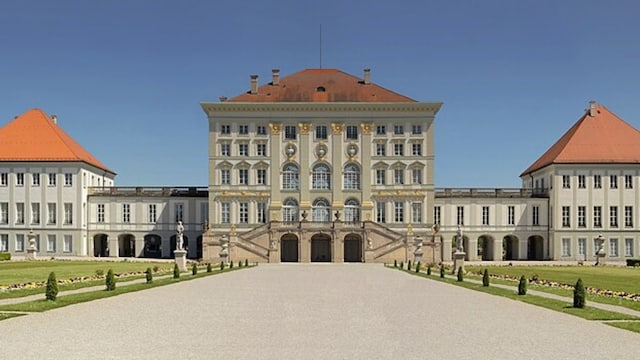
Image source: Wikimedia Commons
For travellers intrigued by contemporary innovation, Munich shifts effortlessly from imperial courts to futuristic engineering. Out by the Olympiapark, the swooping architecture of BMW Welt showcases the cutting edge of automotive mobility, while its neighbouring museum charts a century of engineering breakthroughs. Further into the river islands of the Isar, the iconic Deutsches Museum stands as one of the world’s most expansive science and technology institutions, housing historical aircraft, oceanic exploration vessels, and interactive physics exhibitions.
Moving between the festival and the city’s cultural quarters is remarkably effortless courtesy of Munich’s MVV transit network, which connects underground U-Bahn trains, overground S-Bahn lines, and street-level trams into a single seamless grid. Picking up a day pass or transit tourist card allows you to hop between museums, palace gardens, and beer gardens without navigating ticket machines at every turn. While tap-to-pay and credit cards are widely accepted across modern venues, carrying physical euro notes remains wise for smaller food stalls, bakeries, and tipping tent servers.
Whether you are climbing church spires, wandering through palatial gardens, or marvelling at river surfers in the park, exploring Munich beyond the festival grounds transforms a simple beer trip into an unforgettable Bavarian voyage.