

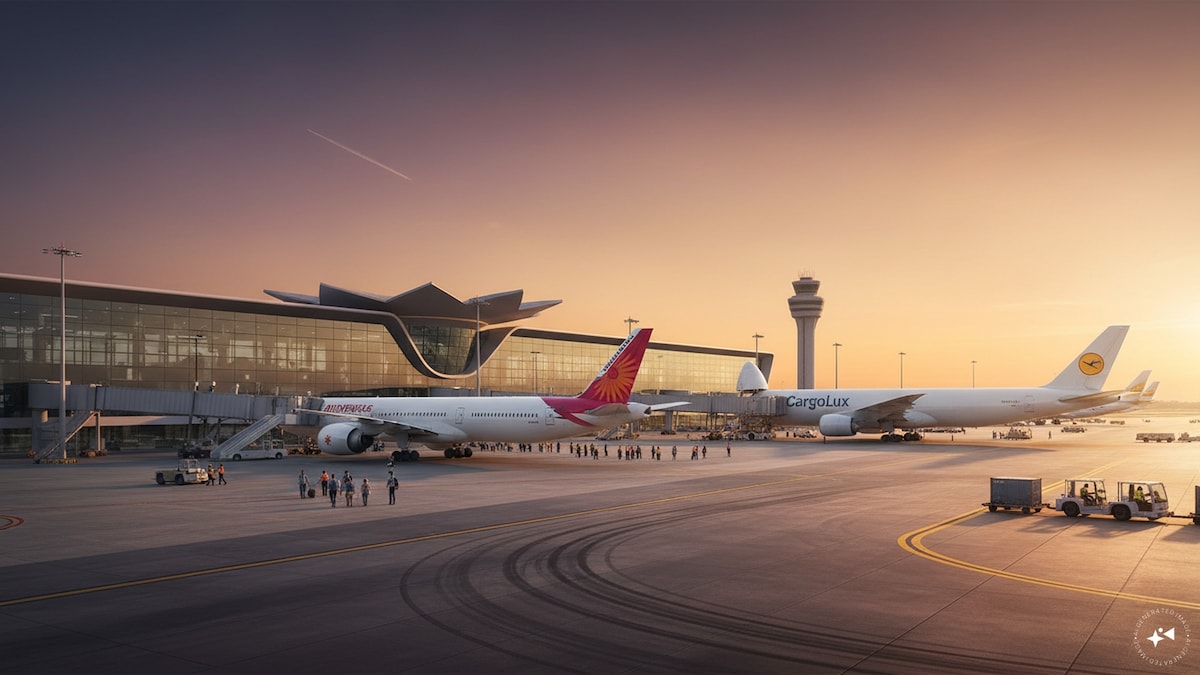
The revised plan gives international passenger and cargo airlines landing-charge waivers and discounts.
The change follows a request from Navi Mumbai International Airport Limited (NMIAL), which asked AERA to revise the route eligibility rule so the incentive is more closely tied to traffic growth at the airport.
Under the new plan, the eligibility rule changes from a “New Route in the Mumbai Metropolitan Region” to a “New Route from NMI”. This means any new international route launched from NMI can now qualify for reduced landing charges.
Landing charges make up a large part of the cost of an air ticket. A full waiver in the first year of a route gives airlines room to offer lower fares when they launch.
Fee Cuts Explained
Under the incentive plan, short-haul international passenger routes of up to 5,000 km will get a 100% waiver on landing charges in Year 1 and a 50% discount in Year 2.
Long-haul routes above 5,000 km will get a 100% waiver in Year 1, a 50% discount in Year 2 and a 25% discount in Year 3. Additional international flights on existing routes will get a 50% discount for short-haul services and a 75% discount for long-haul services in Year 1.
International freighter services will get a 90% discount in Year 1 and a 50% discount in Year 2. This is expected to help air cargo and logistics movement from Navi Mumbai.Airlines, Flyers Benefit
The revised plan makes routes more profitable for domestic and international carriers, which should encourage airlines to launch new direct international destinations from Navi Mumbai.
For flyers across Maharashtra and western India, this could mean more flights, better schedules and more competitive international fares.
The airport says the move supports its goal of growing traffic, using its international terminal more fully, and becoming a major global aviation hub.
The airport, built under a public-private partnership between Adani Airport Holdings Limited (AAHL) and CIDCO, is designed to handle 20 million passengers a year (MPPA) in its first phase, scaling up to 90 MPPA and 3.2 million tonnes of cargo capacity at full build-out.