
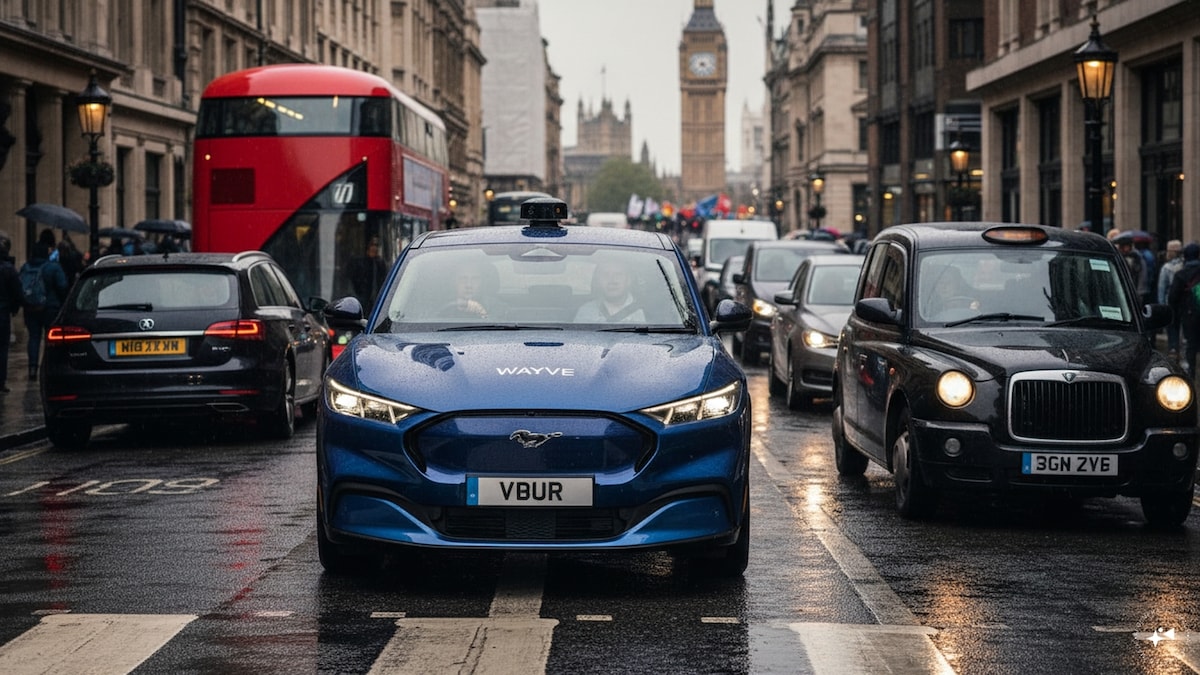
The service began on Thursday with a small fleet of all-electric Ford Mustang Mach-E vehicles fitted with Wayve’s AI Driver.
Passengers requesting UberX, Uber Electric or Uber Comfort in London may be matched with a Wayve vehicle at no additional cost. The cars can take passengers to destinations across London, although airports are excluded from the launch area.
Riders cannot specifically request a Wayve vehicle, but if they are matched with one, they can accept it or switch to a conventional Uber before the vehicle arrives. The fare is shown in the app and does not cost more than a regular eligible Uber trip.
The service is not fully driverless. Each Wayve vehicle will have a trained private-hire driver licensed by Transport for London (TfL) in the car to supervise the journey and take control when required.
The vehicles themselves do the driving during autonomous operation. Riders can unlock the vehicle and start their trip through the Uber app, while screens inside the car show information including the vehicle’s planned route.
Human Still Drives
Wayve and Uber are starting with a small fleet and plan to increase the number of vehicles as demand, technology and regulations allow. More than 140,000 Londoners have opted in through Uber’s Ride Preferences settings, increasing their chances of being matched with a Wayve vehicle. Passengers will not be prompted to tip after a Wayve autonomous trip.
Wayve has been testing its autonomous-driving technology on London roads since 2018. Its “AV2.0” system uses an AI Driver trained on driving data rather than depending on traditional high-definition maps and extensive hand-coded rules. The company says this approach allows the system to adapt to different roads, vehicles, weather conditions and cities.
London Test
The launch comes as companies including Waymo, Baidu and other autonomous-driving operators prepare to expand robotaxi services in Europe.
Robotaxis are already operating without human drivers in several US and Chinese cities, but European deployments have moved more slowly because of regulatory requirements and the complexity of urban roads.
London presents particular challenges because of its narrow and irregular streets, congestion, buses, cyclists and pedestrians.
Wayve’s London service is its first public commercial deployment. During recent demonstrations, its vehicles have navigated congested traffic, lane changes and pedestrians, while safety drivers have intervened when necessary.
The current service operates under the UK government’s framework for automated-vehicle trials and Uber’s TfL private-hire operator licence.
Driverless Next
The launch does not yet allow Uber and Wayve to remove the human safety driver. Fully autonomous passenger services require further regulatory approvals, including processes involving the Vehicle Certification Agency, the Driver and Vehicle Standards Agency and TfL.
Wayve’s future plans include Nissan LEAF vehicles using its AI Driver, with a pilot planned in Tokyo later this year in partnership with Nissan and Uber.
For Uber, the London launch is part of a wider strategy to operate autonomous and human-driven vehicles through the same platform. The company says it is working with more than 30 autonomous-vehicle partners across mobility, delivery and freight and expects to facilitate autonomous trips in as many as 15 cities globally by the end of 2026.