
Before I could get over the breathtakingly tasty, no-frills, unassuming dal, a few innocuous pieces of fried karela (bitter gourd) stared at me from the corner of the plate.
All I’ve is disdain for the vegetable, which has tasted like half-cooked nails every time I tried it. The seeming attempt of four pieces of karela chips to escape over the rim of my plate was actually a delicious trap.
I grabbed a piece to crush it with all the forgotten contempt I had just been reminded of. But, just a bite made me think if I should reconsider the animus I felt for someone I am supposed to love.
It’s just one of the many jolts Sikkim, a state with no income tax, has in store for travellers like me.
You pay for the privilege of summer snow
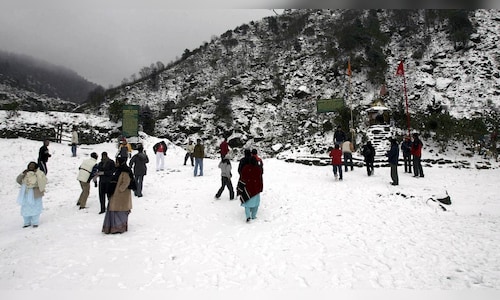
It must be a privilege to touch snow in peak summer; an even bigger blessing to feel cold, unadulterated air stroke the roof of your nostril, on the same day when folks back in Mumbai were gasping for breath while the weather app on their phone screamed 38 degree celsius.
Some trips stay with you because they are beautiful. And then some trips stay with you because they constantly remind you of nature’s might. Sikkim was both. Along with the memories, I returned with a renewed respect for the unpredictability of Himalayan travel.
Here are some notes that may be useful if you’re planning a trip to Sikkim.
It costs more than other destinations
Travelling in Sikkim can cost more than many first-time visitors expect. A cab from Bagdogra (the closest airport) to Gangtok, and thereon from Gangtok to Lachung in North Sikkim and back, combined with a ride back to the airport, can cost you up to ₹45,000 during peak tourist season.
The reasons become obvious once you are there. Distances are long, roads are often difficult, and many routes require specialised local vehicles and permits. Even relatively short journeys can take several hours because of mountain conditions.
The cab drivers charge you extra, up to ₹4,000, for a trip to Zero Point, which is at a height of over 15,300 feet above sea level, from Lachung.
The landscape at Zero Point is stark, dramatic, and raw. The cold hits hard, the oxygen gets thinner, and a hot cup of instant noodles tastes better than ever. On the flip side of the light-headed experience without any substance abuse is that transportation becomes one of the biggest expenses of the trip.
You can offset it by opting for relatively cheaper stays. Hotel-wallahs will tell you rooms are sold out, but there’s enough inventory (even during peak season) in the ₹2,000-₹4,000 range to take the sting out of the cab bill. Some of these rooms can comfortably accommodate up to 4 people.
The simplest way to reduce costs is to travel in a group and split vehicle expenses, aside from the fact that joy multiplies when shared, like a bonfire.
But beyond money, the bigger thing to budget for is time
Like many travellers heading to North Sikkim, I had planned to visit Gurudongmar Lake. But the road from Lachen to the lake had recently caved in, and the route was closed.
If the road to Gurudongmar reopens in the coming months, I recommend not rushing the itinerary. Many packaged tours compress North Sikkim into two or three exhausting days. That may work on paper, but in practice, it becomes frantic.
If you want to comfortably cover both Zero Point and Gurudongmar without turning the trip into a logistical marathon, keep at least four days for North Sikkim alone. The distances are deceptive, the terrain is demanding, and weather delays are common.
While you prepare for it, remember that the trip you plan may not be the one you get.
When the map tells you something is 4 hours away, it’s good to read it as 6 or 7. Landslides, road collapses, weather disruptions, and permit restrictions are not exceptions — they are part of the experience.
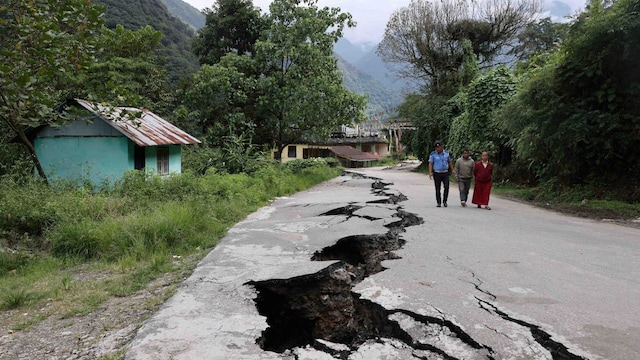
FILE PHOTO | People walk along a road with cracks caused by flash floods in Naga-Namgor village, Sikkim, India, October 10, 2023. (Reuters)
Finish North Sikkim before Gangtok
After the rough terrain and remote landscapes of North Sikkim, Gangtok feels remarkably organised and less tiring. It will give you time to recover, and the visit to Nathu La becomes breezy.
What stood out immediately was how clean the city is. Public spaces are well maintained, traffic is relatively disciplined, and there is a visible civic pride that many tourist towns elsewhere struggle to sustain.
Pull out a cigarette in a public space and watch people panic on your behalf. “Hide in a corner, the police will catch you” is a warning that comes from more than one person. It’s a phenomenon I’ve experienced in some parts of Kerala, but the enforcement seems stricter in Sikkim.
Leave as early in the day as you can, because Nathu La is very touristy, and even though the roads are bigger, you may get stuck in a traffic jam that starts a few kilometres before your destination.
If you leave your hotel at 7 am, you can expect to be back in Gangtok by noon, after spending a few minutes at the Baba Harbhajan Singh shrine and the Tsongmo lake.
If you’re looking for solitude, don’t go to Nathu La. The place is part scenic, part historical and geopolitical landmark, and part theme park.
Do not carry use-and-throw plastic bottles. They will confiscated.
The military presence, which is a feature across Sikkim, can be overwhelming at Nathu La, where you’re an arm’s length away from the border separating India and China.
One place that deserves far more attention than it usually gets is the Namgyal Institute of Tibetology.
The museum offers a fascinating window into Tibetan Buddhist history, philosophy, iconography, and the various schools and factions within the tradition.
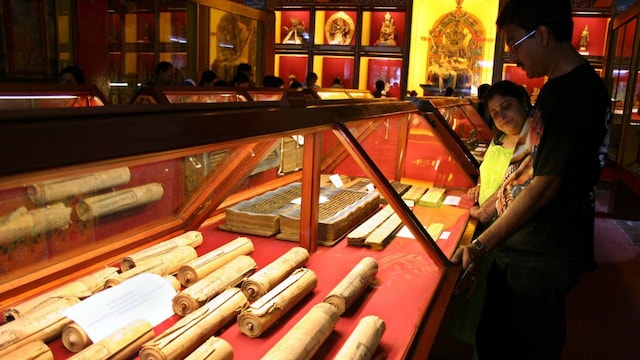
FILE PHOTO | Tourists look at a collection of scriptures at an institute of Tibetlogy in Gangtok, capital of India’s northeastern state of Sikkim May 29, 2006. (Reuters)
It also quietly reveals the political and cultural dynamics that shaped the Himalayan region over centuries. Visiting it gives context to the monasteries, prayer flags, rituals, and symbols you encounter throughout Sikkim.
Give the mountains time
If possible, keep at least two weeks for a Sikkim trip. It’s near impossible to cover the breadth of the state in a week and to return with a functional spine.
If you make Gangtok your base camp, you will need as many days to cover areas like Pelling and Namchi in the western part of the state as you would to traverse the north. I chose to leave West Sikkim for my next trip.
Also Read: MakeMyTrip upgrades AI chatbot Myra with end-to-end booking features
Fatigue from the high altitude and long drives accumulates. Trying to “optimise” a Himalayan itinerary too aggressively usually backfires. So don’t rush it. Be willing to let go of a few items on your checklist and soak in the place you’re at.
And most importantly: keep at least one buffer day before your flight home. Flight cancellations and disruptions at Bagdogra Airport are common. That extra day can save an enormous amount of stress.
Sikkim is not the kind of destination you conquer with an itinerary spreadsheet. It demands patience, flexibility, and respect for the terrain. An open mind gets rewarded with surprisingly delicious karelas.
Also Read: Abu Dhabi picks Yas Island for first Sphere venue outside US: Check full details