
Last Updated:
In the process, the Congress handed the ruling BJP exactly what it thrives on — proof of opposition disarray.



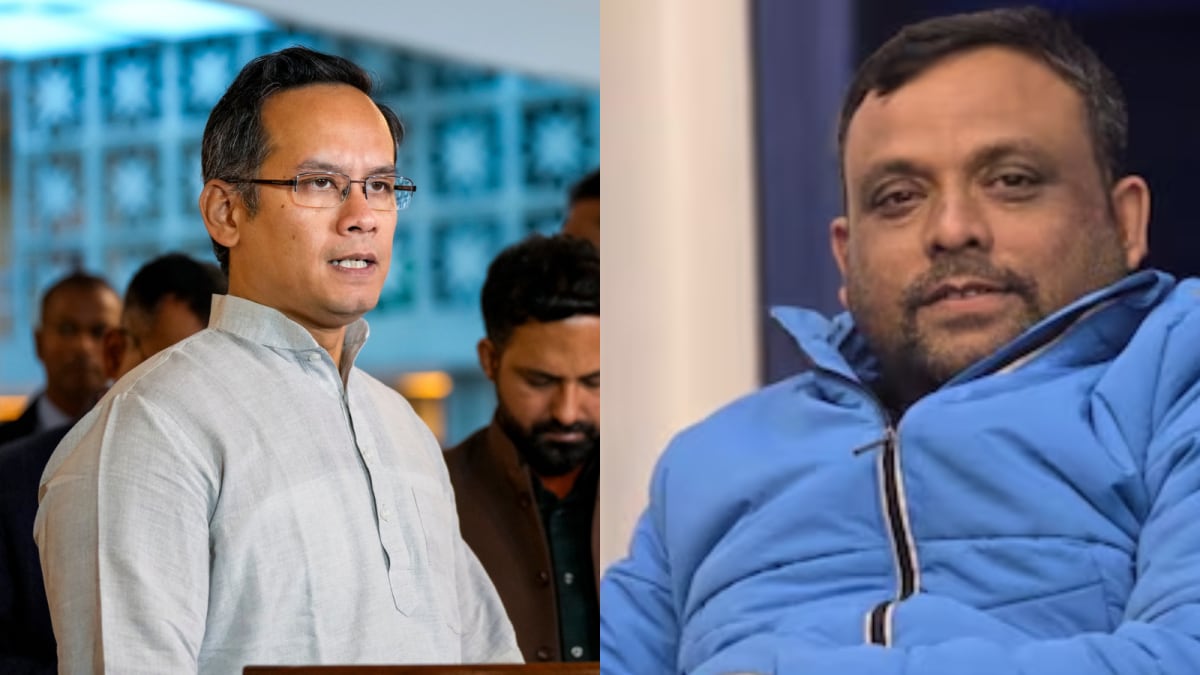
For Gaurav Gogoi, the Rejaul Karim Sarkar controversy has become a referendum on his leadership. (Image: PTI)
The brief and chaotic induction of former All Assam Minorities Students’ Union (AAMSU) president Rejaul Karim Sarkar into the Assam Pradesh Congress Committee (APCC) has done more than triggering a controversy — it has laid bare the Congress party’s deepening structural, ideological, and leadership crisis in Assam.
What unfolded over just 60 hours in mid-January was not an isolated misstep, but a symptom of a party struggling to reconcile competing political instincts: minority consolidation versus indigenous reassurance, central strategy versus local sensibilities, and ambition versus institutional discipline. In the process, the Congress handed the ruling BJP exactly what it thrives on — proof of opposition disarray.
Sarkar’s induction on January 11 was clearly designed as a calculated political move. With the 2026 Assembly elections approaching, APCC president Gaurav Gogoi sought to expand Congress’s footprint among minority voters, particularly Muslims in lower Assam districts such as Dhubri, Barpeta, and Goalpara. Sarkar, a prominent student leader with grassroots influence, appeared to fit the bill: young, vocal, and inspirational.
But the strategy collapsed almost immediately. Sarkar’s public remarks invoking the idea of “Bor Asom” (Greater Assam) and suggesting that culturally significant districts like Sivasagar and Tinsukia could be “transformed” into Dhubri were interpreted as endorsing demographic change. In a state where identity, indigeneity, and migration remain politically explosive — shaped by decades of agitation, NRC anxieties, and CAA fallout — the remarks struck a raw nerve.
Protests erupted across Upper Assam. Civil society groups and regional outfits burned effigies and issued ultimatums. The backlash was swift and unforgiving.
What followed exposed a far more damaging reality: Congress’s internal incoherence. Senior leaders Debabrata Saikia, the Leader of Opposition, and Nagaon MP Pradyut Bordoloi publicly distanced themselves from Sarkar and condemned his remarks as “irresponsible” and “damaging.” Local party units echoed the criticism, implicitly questioning the judgment of the APCC leadership.
The spectacle of senior leaders contradicting the party president in public was striking. It signalled not merely disagreement over one induction, but a deeper lack of trust in Gogoi’s leadership and decision-making process. Sarkar’s eventual resignation on January 14 — just 60 hours after joining — came with incendiary accusations that Saikia and Bordoloi were acting like “BJP agents,” further escalating the internal rift.
For Gaurav Gogoi, the controversy has become a referendum on his leadership. Since taking charge of the APCC in 2024, Gogoi has tried to project a more inclusive, forward-looking Congress aligned with national opposition politics. However, the Sarkar episode has reinforced perceptions of indecision, weak internal consultation, and poor vetting mechanisms.
His reluctance to take firm disciplinary action — allowing Sarkar to resign rather than expelling him — invited ridicule from Chief Minister Himanta Biswa Sarma, who accused Gogoi of lacking “courage to act.” More damagingly, it allowed Sarkar to exit as a self-styled victim of internal sabotage rather than as a political liability.
At its core, the controversy reflects a fundamental tension within the Assam Congress. One faction, aligned with Gogoi, believes the party must aggressively consolidate minority voters to remain electorally relevant. Another, represented by Saikia and Bordoloi, fears that such moves — if poorly calibrated — will alienate indigenous Assamese voters, especially in Upper Assam, where Congress has already been losing ground.
This fault line is not new. It has simmered since Gogoi’s elevation, with whispers of a divide between “Delhi-aligned reformists” and entrenched state-level leaders. The Sarkar episode merely forced the conflict into the open.
The timing could not be worse. Congress won just 29 seats in the 2021 Assembly elections and remains a fragile opposition. Any perception that it is insensitive to Assamese identity or incapable of internal discipline plays directly into the BJP’s dominant narrative.
The ruling party has already seized on the controversy to portray Congress as “anti-Assamese,” divided, and opportunistic — an image reinforced by protests, social media backlash, and visible infighting. Worse, voter disillusionment could drive support towards regional alternatives like the Assam Jatiya Parishad or Raijor Dal, further fragmenting the opposition space.
The Sarkar implosion is not just about one leader or one statement. It is a warning sign of a party struggling to align strategy, leadership, and ground realities. Without clearer decision-making structures, disciplined communication, and genuine internal consensus, the Congress risks entering the 2026 elections weakened not just by the BJP, but by itself.
January 16, 2026, 11:38 IST
Read More