
Last Updated:
Throughout her political career, Mamata Banerjee has often taken actions criticised as improper or confrontational, yet many of these moves have yielded political dividends



TMC leaders maintain that Banerjee is back in her old form. File Image
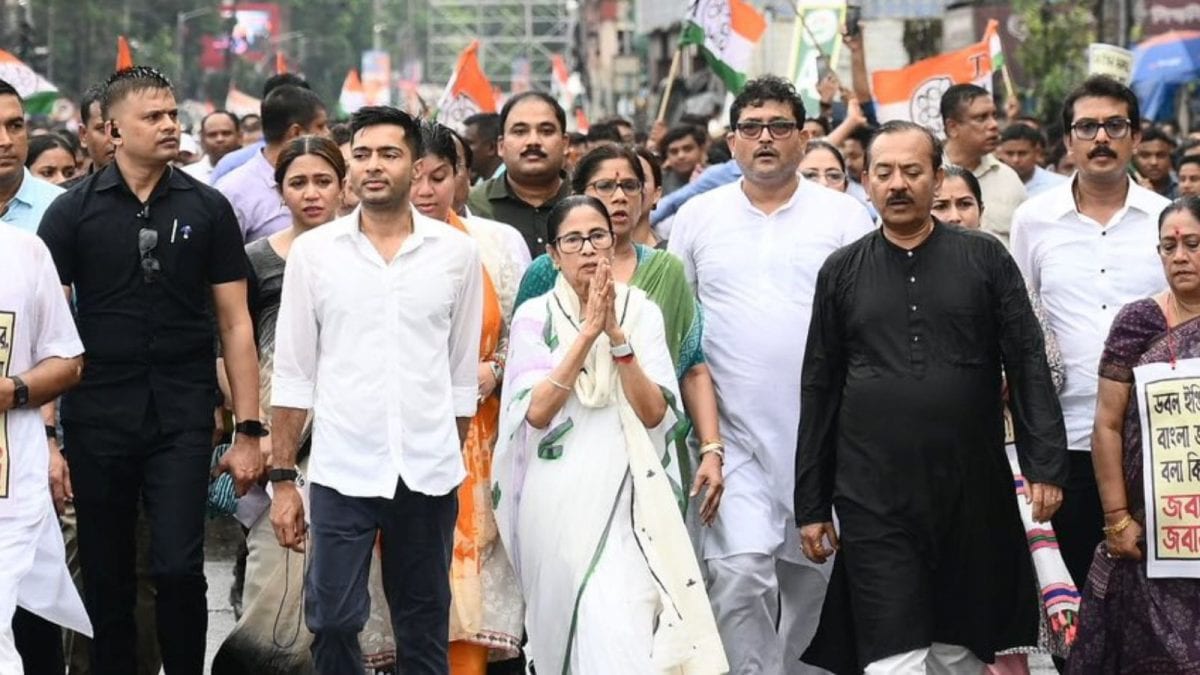
Mamata Banerjee has long been known for her street-fighter style of politics. While her decision to enter the site of an Enforcement Directorate (ED) raid has raised legal questions about the propriety of such an act, politically, this approach has often worked in her favour.
As the West Bengal Chief Minister announced that she would take to the streets in protest against what she described as the misuse of central agencies, her speech at a rally signalled a shift to an aggressive election posture. Mamata Banerjee herself framed the moment in combative terms, saying, “An injured tiger is more dangerous than a healthy tiger.”
The ED has already approached the courts, seeking a CBI investigation into the role of the West Bengal Chief Minister, senior police officials, and others for allegedly obstructing its raids in Kolkata against political consultancy firm I-PAC and its director on Thursday.
Experts have questioned the legality of her actions during the ED episode. However, politically, Banerjee appeared determined to reassert her image as a street fighter. Addressing supporters, she said, “If no one attacks me, I fall asleep and listen to the legends of Ramakrishna or Krishna. If I am attacked, I find new life. Yesterday, I felt alive again.”
The statement underlined her readiness for a direct confrontation with the ED and her effort to build a narrative of political vendetta against the Trinamool Congress (TMC). On several occasions following her recent 7-kilometre walk, Banerjee reiterated that any attack would be met with a counterattack. She has accused the ED of acting as a political tool of the BJP to “steal” her party’s internal strategy ahead of the assembly elections expected soon.
Friday’s rally, in effect, functioned as an early election campaign event. Throughout her political career, Banerjee has often taken actions criticised as improper or confrontational, yet many of these moves have yielded political dividends. In 2006, after being prevented from entering Singur, she entered the West Bengal assembly, an episode that saw vandalism by party workers and drew sharp criticism. However, among Singur’s farmers, the incident elevated her stature.
Similarly, in 2021, when TMC leaders Firhad Hakim and Subrata Mukherjee were arrested by central agencies, Banerjee staged a dharna in their support. In 2019, Mamata sat on a dharna for IPS officer Rajeev Kumar as Cthe BI came to question him.
Her recent actions also carried a message for party leaders and workers: if the BJP comes to power, resistance is necessary, and if the Chief Minister herself can confront central agencies, others should not hesitate to do so.
Reacting to Banerjee’s renewed activism, BJP state president Samik Bhattacharya said, “No matter how many kilometres she walks, people have seen how far Mamata Banerjee can fall morally. No walk will save her this time.”
TMC leaders maintain that Banerjee is back in her old form. Whether this return to street politics will translate into an expansion of the party’s vote base remains an open question as the election season approaches.
January 10, 2026, 03:40 IST
Read More