
Last Updated:
When Afzal Guru faced the gallows under a Congress-led UPA government, there were no statements on bail as a fundamental right, no concern over prolonged incarceration.



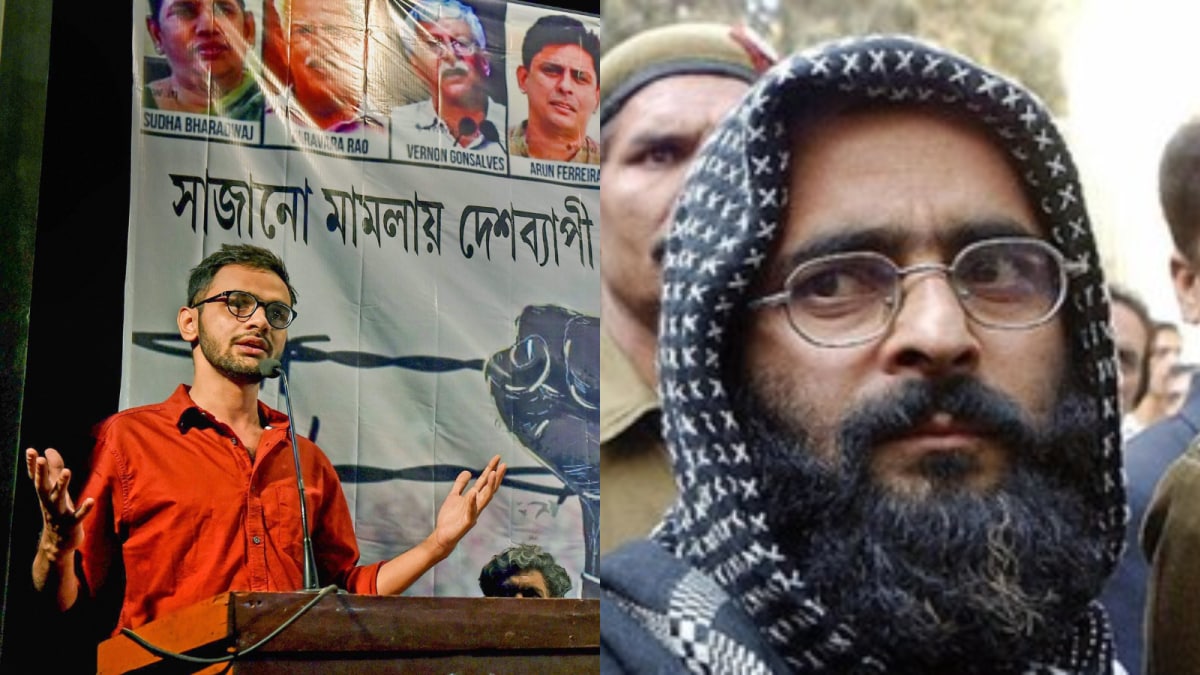
When the state framed its case against Afzal Guru in 2001 and Umar Khalid in 2020, the legal language sounded strikingly familiar. (Image: PTI)
Almost two decades apart, the locations could not be more different — from the high-security corridors of Parliament to the narrow lanes of north-east Delhi. And yet, when the state framed its case against Afzal Guru in 2001 and Umar Khalid in 2020, the legal language sounded strikingly familiar.
What has changed sharply, however, is the political response — particularly that of the Congress.
Today, senior Congress leaders are openly criticising the Supreme Court’s refusal to grant bail to Umar Khalid. Imran Masood has said bail is a fundamental right and Khalid deserved it. Priyank Kharge has pointed to what he calls double standards — asking why Khalid remains behind bars while high-profile convicts walk free on bail. Udit Raj has termed the apex court’s decision “unfortunate”.
But that political outrage sits uneasily alongside the Congress party’s own past.
Because when Afzal Guru faced the gallows under a Congress-led UPA government, there were no statements on bail as a fundamental right, no concern over prolonged incarceration, no discomfort with the harshest exercise of state power. Guru was never granted bail. Congress never questioned his prolonged incarceration. He was executed inside Tihar Jail in 2013 — quietly, swiftly, without his family being informed in time or allowed a final meeting.
That contrast raises an uncomfortable question: why the empathy now, and not then?
What often gets lost in the noise is that Khalid is accused under a legal framework that mirrors the one used against Guru. Both men, investigators say, were not the ones pulling triggers or lighting fires. Both are accused of plotting.
Guru was accused of arranging logistics, shelter and support for the terrorists who attacked Parliament. Khalid, Delhi Police allege, helped draw up a plan and incite violence during the 2020 Delhi riots — through speeches, meetings, messages and coordination, while staying away from the streets himself.
The laws have changed, but the architecture has not.
Guru was booked under POTA, the Explosives Act and IPC provisions dealing with waging war, conspiracy and murder. Khalid faces UAPA, the Arms Act and the same core IPC sections. In both cases, conspiracy is the spine of the prosecution. Intent is the battlefield. And the use of stringent anti-terror laws makes bail a near-impossible proposition.
Place the two chargesheets side by side and the overlap is hard to miss.
One involved a conspiracy behind a direct terrorist assault on the nation’s highest institution. The other emerged from protests that spiralled into communal violence. The scale and symbolism differ, but the legal logic does not.
Both cases rest heavily on indirect evidence. In Afzal Guru’s trial, it was phone records, recoveries and testimonies. In Umar Khalid’s case, it is speeches, WhatsApp chats, protest meetings and protected witnesses. Physical presence at the site of violence is not central to either prosecution; the allegation is orchestration from behind the scenes.
There are, of course, crucial differences. Afzal Guru was convicted and executed, with the Supreme Court calling the Parliament attack an assault on the nation itself. Umar Khalid’s trial is still underway. He denies all charges and insists his arrest criminalises dissent. Unlike Guru, Khalid is not accused of links to foreign terror outfits, but of attempting domestic destabilisation under the cover of protests.
And yet, the common thread remains unmistakable.
When the Indian state invokes national security, conspiracy becomes its most powerful charge — elastic enough to connect words to violence, meetings to murder, and intent to terror. It is a charge that leaves little room for bail, and even less for political nuance.
Which is why the present-day outrage over Umar Khalid’s incarceration inevitably circles back to Afzal Guru — and to a Congress party that once presided over an execution in silence, but now speaks loudly of rights, fairness and bail.
The question is not just legal. It is deeply political.
January 08, 2026, 09:17 IST
Read More