
Last Updated:
The archaeology department’s official survey of the stone pillar drew legal objections that the state was improperly generating new evidence while the matter was sub judice

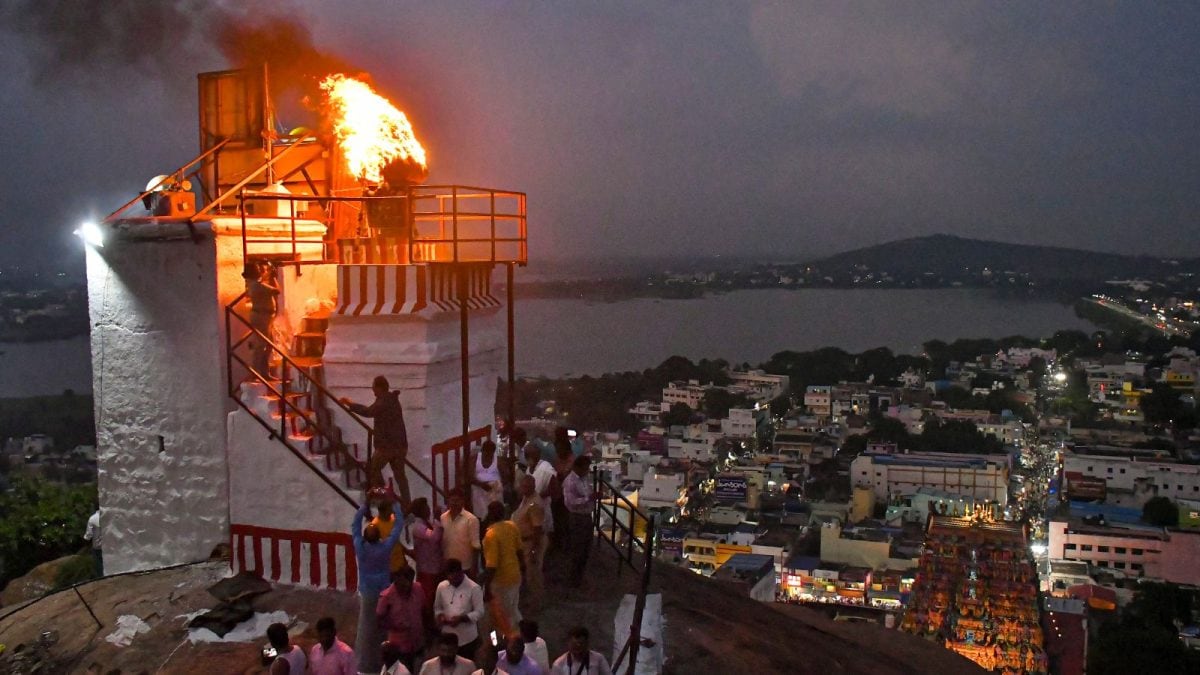
A lamp lit at Thiruparankundram temple as part of ‘Karthigai Deepam’ festival celebrations, in Tamil Nadu’s Madurai district on December 3, 2025. (Image: PTI)
A decades-old religious ritual at a temple in Madurai has sparked a major political and legal storm in poll-bound Tamil Nadu, stemming from a single court decision allowing the lighting of the traditional Karthigai Deepam lamp at a stone pillar located close to a dargah.
The Tamil Nadu archaeology department is the newest entrant in the row surrounding the lighting of the ritual lamp at the deepathoon (stone pillar) of the Subramaniya Swamy temple on Thiruparankundram hill.
Even as the Madras High Court allowed a heavily restricted “peaceful fasting” protest by local residents, who are demanding the ritual be permitted, on December 11, the state’s archaeology department conducted an official survey of the stone pillar. This immediately drew legal objections from petitioners, who argued that the state was improperly generating new evidence while the matter was sub judice.
The Thiruparankundram hill in Madurai is a site revered for both its historic Subramaniya Swamy temple and the nearby Sikkander Badusha dargah.
WHAT IS THE LATEST DEVELOPMENT?
The Tamil Nadu archaeology department’s official survey at the stone pillar has added a new layer of complexity to a matter, which is still under legal scrutiny.
According to a report by The Indian Express, on December 10, a seven-member team from the department – led by deputy director Yatish Kumar and assistant director Loganathan – conducted a survey of the deepathoon and the surrounding area. The report quoted officials as saying the exercise was intended to provide a detailed technical analysis to study the physical characteristics of the pillar, which some parties claim is merely a survey stone.
The report said the timing of this action, however, raised immediate legal concerns. Legal petitioners in the matter questioned how the state could undertake such an exercise when the core dispute was pending before appellate courts.
Petitioners argued that any new material generated through the survey could fundamentally alter the nature of the dispute if presented before the court, underscoring the “fraught relationship between judicial proceedings and executive action”.
A ‘PEACEFUL’ HUNGER STRIKE
This survey came alongside the Madras High Court’s decision to allow a peaceful hunger strike by local residents, who are demanding for the ritual to be performed at the location.
Justice S Srimathy issued the order on a petition filed by R Prabhu, an advocate from Thiruparankundram, who sought permission for public “peaceful fasting” at Mayil Mandapam on Sannidhi Street on Saturday (December 13). The protest was explicitly aimed at demanding permission to light the Karthigai Deepam on the deepathoon.
Justice Srimathy, while acknowledging the state’s opposition that the core dispute was pending, held that a hunger strike constitutes a form of expression protected under the Constitution and, thus, could not be denied outright, though authorities could regulate it. The court, however, imposed strict conditions – only 50 participants were permitted to take part between 9 am and 5 pm, using only one microphone; no slogans against individuals or groups were permitted except mantras; no political colour by either the petitioner or the police; and the entire protest should be videographed.
WHAT TRIGGERED THE CONTROVERSY?
The current controversy was initially triggered by a series of orders from Justice GR Swaminathan of the Madras High Court’s Madurai bench.
The tradition of lighting the lamp on the deepathoon reportedly continued until 1926 but was discontinued due to civil disputes. On December 1, Justice Swaminathan ruled that the Arulmighu Subramania Swamy Temple was “duty-bound” to light the lamp at the deepathoon, in addition to the customary lighting near the Uchi Pillaiyar Mandapam.
The single-judge bench asserted that doing so would “not encroach upon the rights of the adjacent dargah or the Muslim community”. But state government officials viewed this directive as a break from the longstanding practice of lighting the lamp at the nearby Deepa Mandapam, a ritual observed for several years.
When the court’s December 1 order remained unimplemented, Justice Swaminathan passed a subsequent order on December 3 permitting devotees to light the lamp and directing the Central Industrial Security Force (CISF) to ensure their protection. This non-compliance and the resulting chaos, including clashes between right-wing groups and police over the lighting of the lamp, led the DMK-led state government to challenge the order in the Supreme Court.
 Click here to add News18 as your preferred news source on Google.
 Madurai, India, India
December 13, 2025, 12:37 IST
Read More