
Last Updated:
After its Kendriya Marg Darshak Mandal meeting ended, the VHP said the Constitution grants “special privileges” to religious minorities but does not define the term

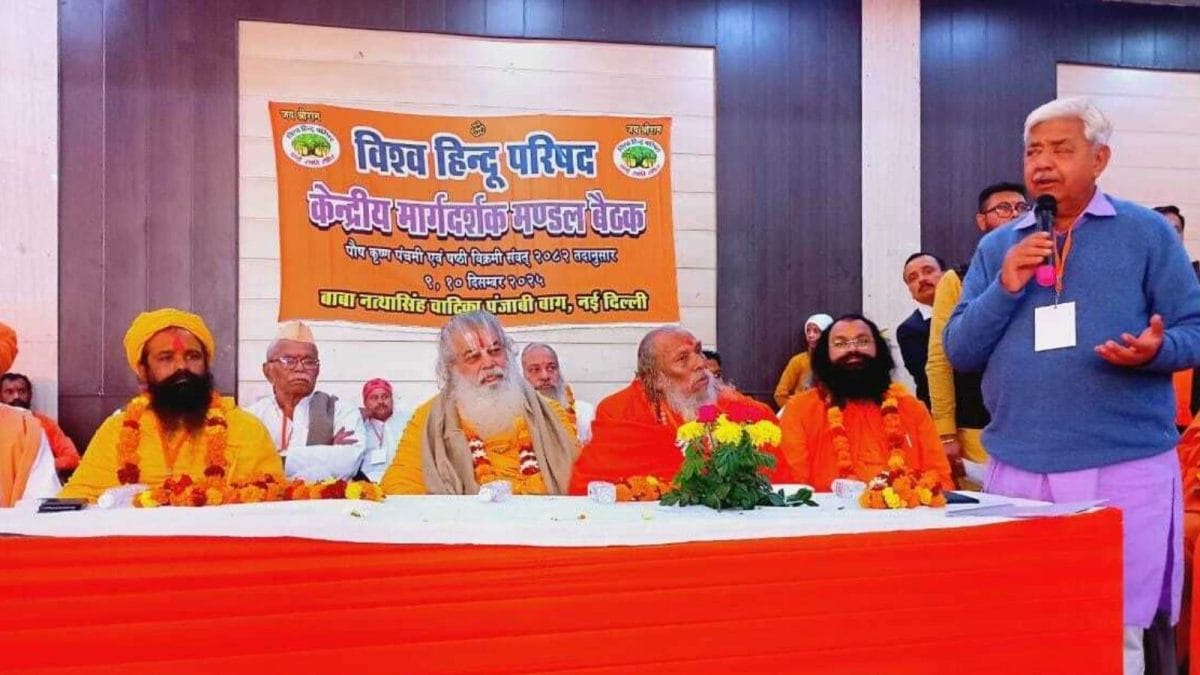
The two-day Kendriya Marg Darshak Mandal meeting of the Vishva Hindu Parishad concluded in New Delhi on December 10, 2025. (Image: News18)
The Vishva Hindu Parishad has given a unanimous call for the Centre to clearly define what constitutes a “religious minority” in India – a question the organisation said has long remained unaddressed despite the constitutional framework around minority rights.
The two-day Kendriya Marg Darshak Mandal meeting of the Vishva Hindu Parishad (VHP) concluded in Delhi with a statement, in which it argued that the Constitution grants “special privileges” to religious minorities but does not define the term.
President of the VHP, Alok Kumar said this ambiguity has allowed the central government “unbridled power” under the National Commission for Minorities Act, 1992, to declare any community as a minority without fixed parameters.
CALL FOR NEW CRITERIA TO DETERMINE MINORITY STATUS
The VHP has proposed two criteria for any community to qualify as a religious minority: one, a history of religious persecution in India, or two, falling behind the rest of society in measurable socioeconomic indicators.
In its statement, it argued that neither criterion fits Islam nor Christianity. “It must be acknowledged that at no point in Indian history the followers of Islam or Christianity had to suffer persecution or discrimination on the basis of religion. They are not behind the rest of society,” the VHP statement read.
Citing census trends, the organisation noted that Muslims formed over 14 percent of the population in 2011 and are “said to have now increased to 18 to 20 percent”. It argued that India’s secular framework rejects discrimination on religious grounds, making a reassessment of minority status necessary.
NOT A CALL TO SCRAP MINORITY STATUS
At present, Muslims and Christians are recognised as religious minorities in India along with Sikhs, Buddhists, Parsis and Jains (who were added to the list in 2014).
Minority communities are notified under Section 2(c) of the National Commission for Minorities Act. States can also declare minorities at their level, but national minority status is granted by the Union government.
While the VHP raised pointed questions about whether this classification should continue, it stopped short of demanding an immediate withdrawal of minority status. Instead, the marg darshak mandal – effectively the outfit’s highest decision-making and ideological council – has asked for a larger debate over the issue across the country.
“The VHP marg darshak mandal has not rushed to any decision. We only seek a discussion before the government arrives at a proper decision,” said one participant to News18, requesting anonymity.
A DEBATE THAT COULD STIR CONVERSATION
The VHP’s intervention is likely to trigger conversations within policy circles, legal forums, and political parties, particularly with minority rights being a sensitive constitutional and electoral issue.
Any attempt to redefine “religious minority” will require revisiting the National Commission for Minorities Act, judicial precedents, and long-standing administrative frameworks. For now, the outfit has placed the subject on the national table – signalling a push for re-examination but leaving the final call to the government.
 Click here to add News18 as your preferred news source on Google.
 December 10, 2025, 22:30 IST
Read More