
Last Updated:
The politics of promise-making in Bihar thrives on aspiration, but it always ignores arithmetic. Tejashwi’s announcement is crafted for applause, not audit

Tejashwi, through his pre-election pledge to the people, is essentially promising to create an additional 2.15 crore government jobs, more than ten times the existing workforce. File image/X
RJD leader and Bihar’s former deputy chief minister Tejashwi Yadav’s promise of “a government job for every Bihari family” sounds less like a well-thought-out and calculated policy and more like election-driven political theatrics.
A close analysis of the official data and documents accessed by News18, which include Bihar’s state budget, its revenue generation capacity, the CAG report (March 2025), the latest NITI Aayog evaluation report, along with the government’s caste census report, reveals that Yadav’s pre-election promise is just a showy pledge with arithmetic that collapses as soon as one tries to balance the books.
For context, here is a fresh look at the scale. Recent state-level projections put Bihar’s population at roughly 127 million (2025 projection) and the state’s average household size at about 5.4, which implies around 23.5 million households (2.35 crore families).
Now, one may look at the current baseline. The Bihar caste survey itself reported roughly 2.05 million people in government employment, which is around 1.57% of the population. That is the working stock of public servants on which the state already spends its salary bill. Here comes the reality check.
According to the promised target, which is one job per family, the state needs to pay the salary for 23.5 million jobs. With 2.05 million (20 lakh) existing jobs, the state needs to generate 21.5 million (2.15 crore) new jobs. And while putting money on top of these headcounts, while checking the recently prepared state accounts, it shows Bihar’s annual expenditure on salaries or wages at over Rs 45,000 crore. That converts to an average annual salary cost of roughly Rs 2.2 lakh per government employee today. Going by the approximate calculation, the promise of a government job for every Bihari family appears economically absurd.
The promise, surely, exploits the yearning for dignity in a state where government employment still symbolises stability and respect, even as the arithmetic behind it mocks reality. Tejashwi, through his pre-election pledge to the people, is essentially promising to create an additional 2.15 crore government jobs, more than ten times the existing workforce.
Even outgoing chief minister Nitish Kumar’s earlier assurance of 12 lakh jobs was ridiculed as unrealistic. This new pledge takes the fantasy further, from exaggeration to economic self-destruction.
A Wage Bill That Could Swallow the State
The 2025-26 budget estimates Bihar’s salary and wage expenditure at around Rs 40,000 to 50,000 crore for roughly 20 lakh employees. That works out to an average cost of Rs 2.17 to 2.2 lakh per employee per year. Multiply that by the 2.15 crore new employees Tejashwi’s promise would demand, and it comes to a figure close to Rs 4.6 lakh crore annually.
According to the Annual Financial Statement of the Bihar Budget 2024-25, the state is estimated to spend Rs 92,882 crore on committed expenditure, which is 41% of its estimated revenue receipts. This comprises spending on salaries (18% of revenue receipts), pensions (14%), and interest payments (9%). In 2024-25, expenditure towards salaries is estimated to register an increase of 24% over the revised estimates for 2023-24. The committed expenditure of a state typically includes expenditure on payment of salaries, pensions, and interest.
To put that in perspective, Bihar’s entire revenue expenditure for 2025-26, covering salaries, pensions, health, education, infrastructure, and welfare, is around Rs 2.5 lakh crore. The proposed wage bill alone would nearly double the state’s entire budget. It is almost the fiscal equivalent of pledging to buy a jumbo jet on a scooter loan.
And that is just the beginning, or it can be seen as the tip of the iceberg. Once pensions, administrative overheads, and recruitment costs are added, the fiscal math does not just bend. It breaks. The CAG (March 2025) report has already flagged Bihar’s rising committed expenditure, warning that over 70% of its revenue receipts go to salaries, pensions, and interest payments.
The NITI Aayog, in its latest summary report for Bihar, ranks the state last in per capita income, showing how little space remains for new fiscal burdens. The report stated, “As of 2022-23, Bihar’s annual unemployment rate, at 3.9 per cent, is slightly above the national average of 3.2 per cent.”
It further added, “Bihar’s real GSDP grew at an average rate of 5.0 per cent between 2012-13 and 2021-22, which is lower than the national average growth of 5.6 per cent during the same period. During the last three decades, Bihar’s share, in nominal terms, in the national GDP decreased from 3.6 per cent in 1990-91 to 2.8 per cent in 2021-22. Its nominal per capita income was only 30 per cent of the national per capita income in 2021-22.”
When Optics Replace Economics
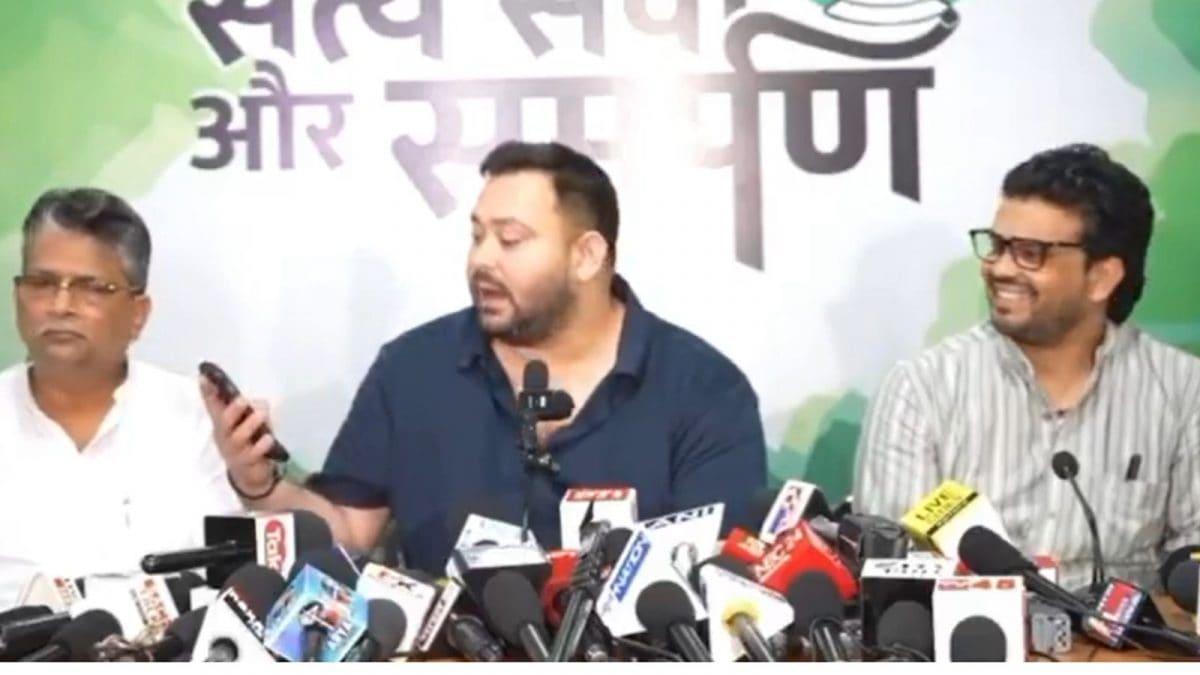
The politics of promise-making in Bihar thrives on aspiration, but it always ignores arithmetic. Tejashwi’s announcement is crafted for applause, not audit. In fact, while announcing, Tejashwi relied more on rhetoric by terming “JOB” as “Jashn Of Bihar”. However, he avoided explaining how.
But such rhetoric creates dangerous expectations and also misleads. A “job per family” is not a slogan but is a structural liability that could lock Bihar into permanent fiscal paralysis, only if any government wishes to keep its pre-election promise. It is a poverty of ambition disguised as populism, where politics promises what economics cannot sustain.

Madhuparna Das, Associate Editor (policy) at CNN News 18, has been in journalism for nearly 14 years. She has extensively been covering politics, policy, crime and internal security issues. She has covered Naxa…Read More
Madhuparna Das, Associate Editor (policy) at CNN News 18, has been in journalism for nearly 14 years. She has extensively been covering politics, policy, crime and internal security issues. She has covered Naxa… Read More
October 10, 2025, 08:00 IST
Read More