
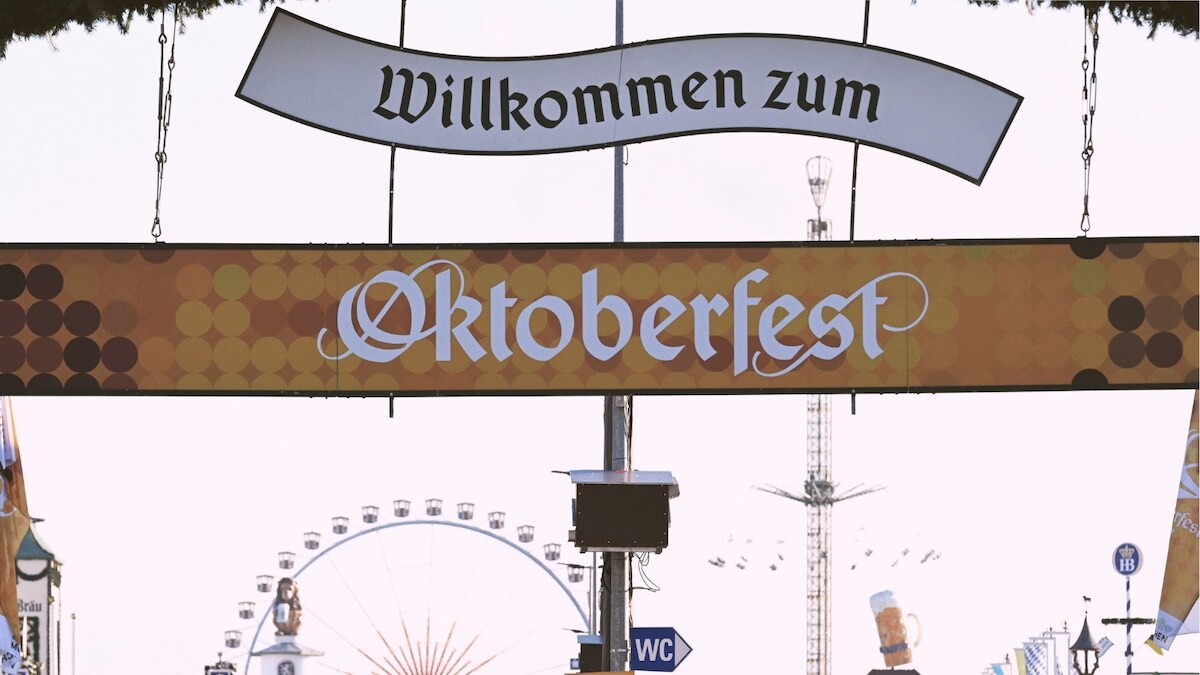
Beer at Oktoberfest is more than a drink. In Munich, it is part of the city’s identity.
Every September, millions of visitors descend on the Bavarian capital for the world’s most famous beer festival. This year, 6.7 million people are expected to attend, generating an estimated $1.8 billion for the local economy.
Yet for an event of that size, the choice of beer is remarkably narrow.
Only six traditional Munich breweries are currently permitted to supply beer to Oktoberfest: Augustiner, Hacker Pschorr, Löwenbräu, Paulaner, Spaten and Staatliches Hofbräuhaus. The city says the restrictions protect the quality and character of the festival. Critics argue that keeping the same breweries in control for generations looks more like a protected cartel.
Now the issue is being challenged again.
Steffen Marx, founder of Giesinger Bräu, has spent years trying to get his beer onto the Wiesn. His brewery began in a garage in 2006 and has since grown into Munich’s seventh brewery producing recognised Munich beer.
In February, Giesinger launched a citizens’ initiative seeking approval to serve its beer at Oktoberfest from 2027. According to a September report by The Wall Street Journal, Marx had gathered 21,000 of the 35,000 signatures needed to call a citywide referendum.
“It’s the hardest battle you can fight in Munich,” Marx said.
The fight is not simply about adding another beer to the festival. It is about who gets to participate in one of Germany’s most valuable cultural and commercial events, and how far a city can go to protect a tradition from competition.
Why are only six breweries allowed?
The answer begins with Munich’s brewing laws. According to the official Oktoberfest website, only beer from established and reputable traditional Munich breweries may be served at the festival. The beer must come from a qualifying Munich brewery and comply with the Munich Purity Law of 1487 and the German Purity Law of 1906.
Munich’s own beer purity regulation dates to 1487, decades before the better-known Bavarian Reinheitsgebot of 1516.
The 1516 decree, issued by Duke Wilhelm IV in Ingolstadt, restricted the ingredients that could be used in beer. The regulation had several purposes. It helped control beer prices, protected grain supplies for bread and was intended to stop brewers from adding potentially harmful or questionable ingredients.
At the time, the role of yeast in fermentation was not understood. The familiar modern formulation recognises malted grains, hops, water and yeast, with provisions for different types of beer.
The 1516 rule was gradually extended beyond Bavaria and became applicable throughout Germany in 1906.
But Oktoberfest has an additional requirement beyond simply following the purity rules.
The beer has to be Munich beer.
The city’s Oktoberfest regulations currently say that only Munich beer from established and proven Munich traditional breweries may be served. The rules also specify that the beer must comply with the Munich Purity Law of 1487 and the German Purity Law of 1906.
Since 2022, Oktoberfest beer has also carried an EU Protected Geographical Indication, protecting the designation and linking the beer to its production in Munich.
Who are the six breweries?
The six breweries are not a group created simply for Oktoberfest. Their histories stretch back hundreds of years.
AUGUSTINER BRÄU
Augustiner traces its origins to 1328, when monks of the Augustinian order founded a brewery. It is the oldest brewery still operating within Munich’s city limits.
At Oktoberfest, Augustiner also preserves one of the festival’s most distinctive traditions. It is the only one of the six breweries that still uses traditional 200 litre wooden barrels, known as Hirschen, for storage and serving.
SPATEN-FRANZISKANER BRÄU
Spaten dates back to 1397. Its most famous contribution to Munich brewing came in 1894, when it became the first brewery to launch Münchner Hell commercially.
The brand is now part of the same international brewing group as Löwenbräu.
HACKER-PSCHORR BRÄU
Hacker Pschorr was first mentioned in a document in 1417. It became one of Munich’s leading breweries in the 18th century under Joseph Pschorr and Maria Theresia Hacker.
The Hacker and Pschorr breweries were later operated separately before being reunited as a brand in 1972. Today, Hacker Pschorr beer is brewed at the same premises as Paulaner.
LÖWENBRÄU
Löwenbräu probably dates back to the late 14th century, although the name first appeared in Munich’s brewing records in 1746.
The brewery grew into Munich’s largest during the 19th century. Its giant lion outside the Löwenbräu festival tent has become one of the most recognisable sights of the Wiesn.
Löwenbräu and Spaten are both part of the international brewing group AB InBev.
STAATLICHES HOFBRÄU
Hofbräu was founded in 1589 as a ducal brewery under Wilhelm V. The brewery was originally located in the centre of Munich, where the famous Hofbräuhaus remains today. Brewing later moved to Munich Riem, and the company has been operated as a state-owned enterprise since 1939. Its Oktoberfest beer is served in the Hofbräu Festzelt.
PAULANER BRÄU
Paulaner is the youngest of the six, tracing its brewing history to 1634, when monks of the Paulaner order began producing their own beer. The brewery became closely associated with Munich’s Nockherberg and its strong beer tradition. Its modern brewing facilities are in Munich Langwied. These six breweries currently supply the beer served at Oktoberfest. But the fact that they have done so for decades does not mean nobody has tried to challenge the system.
The prince who took Oktoberfest to court
One of the most important challenges came from Prince Luitpold of Bavaria.
Luitpold was the owner of König Ludwig Schlossbrauerei Kaltenberg and had an unusually strong family connection to Oktoberfest. His ancestors were connected to the royal wedding celebrations in 1810 that gave rise to the festival.
Yet even that history was not enough to get his beer onto the Wiesn. In the 1980s, Luitpold tried several ways to overcome the city’s restrictions. His brewery initially lay outside Munich. He offered to bring a portable brewery to the festival grounds and brew there, but the city rejected the proposal, arguing that other producers would then demand the same treatment.
Luitpold later established a permanent brewery in a Munich park. The city still found reasons to reject his beer, including concerns over production capacity and restrictions on off-premises sales.
He eventually sued Munich, alleging a cartel and sales monopoly.
The Munich Regional Court rejected his challenge on January 17, 1990.
The court accepted the principle that Oktoberfest was the “Fest des Münchner Bieres”, or “Festival of Munich Beer”, and that restricting the beer served at the festival to Munich beer was justified by the local and traditional character of the event.
The court also considered the possibility that opening the festival to unrestricted competition could allow large breweries from around the world to pay their way into Oktoberfest, potentially pushing aside the traditional Munich character the rules were intended to protect.
That ruling became a key legal foundation for the system that remains in place today.
Why Giesinger is different
Giesinger Bräu is not simply a brewery from outside Munich trying to get into Oktoberfest.
That is what makes the current dispute particularly interesting. Marx founded Giesinger in a garage in 2006 and has spent years trying to satisfy the requirements that govern Munich beer.
One of the biggest hurdles was water. Giesinger pursued a permit to drill its own deep well in Munich. The brewery ultimately secured access to Munich groundwater and invested heavily in expanding its operation. The Wall Street Journal reported that Marx raised €12.4 million for the project and pursued the drilling permit for two years.
The brewery has since become recognised as Munich’s seventh brewery for the purposes of producing Munich beer. But that does not mean it is the seventh Oktoberfest brewery. The six traditional breweries remain the only ones currently permitted to supply beer at the Wiesn. And that distinction is now at the centre of the fight.
Giesinger wants the city to change the rules
In February 2026, Giesinger escalated its campaign by launching a citizens’ initiative. The proposed referendum asks whether Munich should allow Giesinger beer to be served at Oktoberfest from 2027. The brewery needs roughly 35,000 signatures to move the process forward. By the time of the September Wall Street Journal report, Marx said he had collected 21,000. Giesinger argues that the brewery already satisfies the fundamental requirements.
It is in Munich. It has its own Munich deep well. It produces Munich beer and says it complies with the applicable purity rules. So, from the brewery’s perspective, the question is straightforward: if Oktoberfest is supposed to serve Munich beer, why should a Munich brewery be excluded simply because it is newer than the six established breweries?
Munich officials see the issue differently.
Christian Scharpf, Munich’s head of labour and economic affairs and the official responsible for Oktoberfest, has argued that Giesinger could simply submit an application like other Oktoberfest vendors.
The wording of the city’s rules is also significant. They refer to the six breweries as the breweries that are “currently” permitted. Scharpf has argued that this means the list is not necessarily permanently closed. A new brewery could potentially qualify if it meets the requirements and demonstrates that it can handle the organisational, logistical and production demands of Oktoberfest. That leaves Giesinger with a fundamental disagreement over process.
The brewery says it has been trying to get into the Wiesn for years without getting a clear route through city politics. The city says there is already a route: apply.
Is it a cartel?
This is where the dispute becomes an antitrust argument. German antitrust lawyer Fabian Vetter told The Wall Street Journal that the control of the Oktoberfest beer market by the major lager companies looked like a questionable syndicate.
Another German antitrust lawyer, Lukas Kestler, offered a different view. He argued that Munich is entitled to set rules for its own festival and choose breweries that meet those rules. Because the rules are set by the city rather than by the participating breweries themselves, he said Oktoberfest should not simply be described as a cartel.
Neither lawyer represents Oktoberfest participants or the breweries seeking entry. That distinction matters. Calling the system a cartel as a fact would be misleading. The 1990 court ruling upheld Munich’s ability to restrict the beer served at the festival.
The question being raised now is whether the reasons that justified that restriction decades ago should continue to justify excluding a new Munich brewery today.
There is also an unusual element to the ownership structure.
One of the six breweries, Hofbräu, is operated as a Bavarian state-owned enterprise. That is why critics can point to the state itself as being involved in the system.
The beer fight is not the only Oktoberfest fight
The argument over who gets to sell beer is part of a broader fight over who gets to participate in Oktoberfest. This year, the dispute has also reached the giant tents that house the festival. Some of these structures are larger than football fields, rise several storeys and can accommodate around 8,000 people.
Münchner Stubn, a local restaurant, sued Munich in May after losing bids to operate larger tents. The restaurant argued that the bidding system favours families that have run Oktoberfest tents for generations because the process awards points for tradition.
Munich says the bidding process has already been upheld by the courts.
The Bavarian Supreme Court is scheduled to hear the case on September 11. Alexander Egger, chief executive of Münchner Stubn, wants the bidding process opened to vendors from across the European Union. He argues that more competition could lower prices.
The issue is not merely theoretical for visitors.
Last year, some tents charged €15.80 for a litre of beer, around 30% more than typical prices in Munich’s city centre, according to the Wall Street Journal report. The prospect of opening the tents to foreign operators has also produced a familiar argument: that greater competition could change the character of the festival.
Christian Schottenhamel, whose family has operated Oktoberfest’s oldest tent since 1867, warned that opening the system could eventually mean foreign beer and food becoming more common at the festival. He asked whether visitors would want to see Kölsch from Cologne, döner kebabs and pizza replacing the traditional Bavarian offerings.
Egger, who grew up in Munich and has attended Oktoberfest since he was three, says opening the bidding would not necessarily mean changing the menus. Once again, the disagreement comes down to the same question.
How much can Oktoberfest change before it stops feeling like Oktoberfest?
The tradition itself has changed. That question becomes even more interesting when Oktoberfest’s history is examined closely. The festival’s defenders often speak of tradition as though its present form has existed unchanged for centuries. It has not.
Beer from outside Munich was welcome at Oktoberfest during much of the 19th century. Breweries could also serve a wider variety of beers than they do today, according to Austrian beer historian Andreas Krennmair.
Even the dress associated with Oktoberfest is not as old as its image suggests. Dirndls and lederhosen only became an established dress expectation at the festival in the 1990s.
Other arguments over tradition have come and gone too. Two decades ago, debates focused on issues such as a smoking ban and whether traditional Bavarian music should receive more space. More recently, the festival has seen arguments over issues including organic chicken and what constitutes an authentic dirndl.
In other words, Oktoberfest has always been changing.
The argument is really about which changes are acceptable.
What happens next?
For now, nothing has changed on the beer taps. Oktoberfest remains restricted to its six established breweries: Augustiner, Hacker Pschorr, Löwenbräu, Paulaner, Spaten and Hofbräu. Giesinger is trying to change that through the citizens’ initiative launched in February. If the campaign reaches the required threshold and the referendum process moves forward, Munich voters could ultimately have a say over whether Giesinger beer can be served at the festival from 2027.
But the stakes go beyond one brewery.
If Giesinger succeeds, the decision could establish that Oktoberfest’s beer tradition is capable of expanding beyond the six breweries that have dominated the festival for decades.
If it fails, the existing system will have survived another challenge. For Marx, that success could come with an unexpected cost. Giesinger has built part of its identity around being the rebellious outsider in Munich’s beer scene.
Marx has acknowledged that getting onto Oktoberfest could change that image. “If we reach our goal to go to Oktoberfest,” he said, “it’s not the rebel brand anymore.” That may be the irony at the centre of the whole dispute.
Oktoberfest is fighting to preserve its tradition. Giesinger is fighting to become part of it. And both sides are arguing that they are the ones protecting what makes Munich beer special.
Also Read: Hormuz strait talks between Iran and Gulf states postponed as regional tensions deepen