
Last Updated:
Outside the Thane belt, Shinde’s Sena increasingly resembles a marginal player. Single-digit performances are no longer anomalies; they are the pattern.



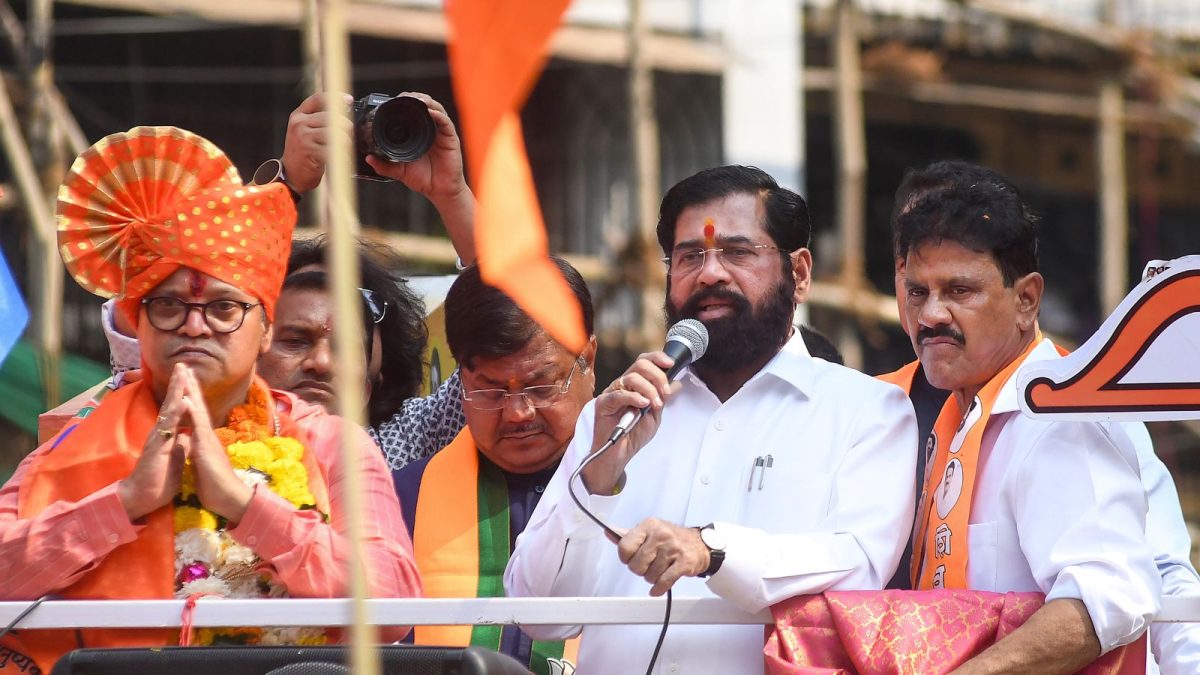
The latest municipal results present an uncomfortable truth for Eknath Shinde’s Shiv Sena: it governs, but it does not truly command. (PTI)

Municipal elections are often dismissed as second-order contests, overshadowed by the drama of Assembly and Lok Sabha polls. But for political parties, especially those claiming grassroots legitimacy, civic elections are the most unforgiving audit. They strip away the cushioning effect of power, personalities, and national narratives, exposing how deeply — or shallow — a party is embedded in everyday urban politics. By that measure, the latest municipal results present an uncomfortable truth for Eknath Shinde’s Shiv Sena: it governs, but it does not truly command.
The headline number initially appears respectable — 399 civic seats statewide. But numbers in isolation are deceptive. More than 55 per cent of these victories, 221 seats to be precise, are concentrated in the Thane district alone. When combined with the 29 seats in the BMC, these two areas account for 250 of the party’s 399 total seats representing approximately 62.6 per cent of their entire statewide strength. This is not merely a stronghold; it is a dependency. Thane, Kalyan-Dombivli, Navi Mumbai, and Ulhasnagar together form a tightly bound political ecosystem where Shinde’s personal authority, administrative familiarity, and inherited organisational loyalty continue to deliver results. Beyond this geography, the party’s footprint rapidly thins out, often vanishing altogether.
This geographic skew matters because a regional concentration is very different from statewide relevance. Outside the Thane belt, Shinde’s Sena increasingly resembles a marginal player. Single-digit performances are no longer anomalies; they are the pattern. Solapur returned four seats, Nanded-Waghala four, Amravati three. Pune and Parbhani drew blanks. These are not fringe towns tucked away from the political mainstream. They are cities that drive Maharashtra’s economy, shape its urban discourse, and historically produce its next generation of leaders. A party that fails to register in these centres cannot credibly claim to speak for Maharashtra’s urban aspirations.
What makes this more politically damaging is the context of alliance politics. Shinde’s Sena is not fighting alone; it is part of a ruling arrangement anchored by the Bharatiya Janata Party. Yet the municipal results reveal a hard truth about this partnership. In cities where the BJP surged — Pune and Nagpur being the clearest examples — the wave stopped short of lifting its ally. Zero seats in Pune and a solitary seat in Nagpur underline a blunt reality: the BJP’s urban appeal does not automatically translate into votes for Shinde’s Sena. In electoral terms, the junior partner is dispensable.
This punctures the central argument that accompanied the 2022 split — that legitimacy, organisation, and cadre strength had decisively shifted camps. If that claim held, municipal elections should have been the arena where it manifested most clearly. Civic polls reward ground-level networks, booth management, and local credibility far more than state or national contests do. Instead, the results suggest something else entirely: what changed hands was power, not popular allegiance.
There are, of course, exceptions that Shinde’s camp points to with pride. Nashik, where the party crossed the 20-seat mark, stands out. But it stands out precisely because it is rare. Elsewhere, modest double-digit tallies in places like Malegaon, Kolhapur, or Chhatrapati Sambhajinagar look less like expansion and more like residue — temporary alignments shaped by local equations rather than a durable organisational surge. These pockets do not yet add up to a coherent statewide presence.
The long-term implications of this pattern are more serious than the immediate optics. Municipal corporations are political nurseries. They generate second-rung leadership, provide financial oxygen to party organisations, and keep cadres engaged between larger electoral cycles. A party absent from most urban local bodies struggles to replenish itself. Over time, it risks becoming less a political force and more a transactional entity — useful during coalition negotiations, but lacking independent weight.
This is where the contradiction at the heart of Shinde’s Sena becomes apparent. At the state level, it enjoys the trappings of authority — cabinet positions, administrative influence, and visibility. At the civic level, it lacks the depth that sustains political movements over decades. Power can command obedience within government; it cannot manufacture conviction among voters. That must be earned repeatedly, ward by ward, election by election.
None of this suggests immediate collapse. The Thane fortress remains intact, and as long as it does, Shinde retains leverage within Maharashtra’s power structure. But fortresses can also become cages. A party confined to one region risks being defined by that region alone, its ambitions shrinking even as its rhetoric remains expansive.
According to Political analyst Pranay Bhise, “While Eknath Shinde has successfully consolidated his base in the Thane Municipal Corporation with a clear majority of 75 seats, the party’s ‘big brother’ status is strictly regional. Outside the Thane-Mumbai corridor, the party’s footprint is surprisingly light, with negligible presence in Nagpur (1 seat) and Pimpri-Chinchwad (6 seats). The data indicates that without a formal alliance with the BJP, the Shinde faction struggles to project power as a state-wide alternative.”
The municipal verdict, taken as a whole, sends a clear message. Shinde’s Sena is administratively relevant but electorally uneven; influential in government but fragile on the ground. Maharashtra’s urban voter has not fully bought into the post-split narrative. Until that gap is bridged, the party’s authority will rest more on arithmetic inside the Assembly than on arithmetic at the ballot box.
In politics, power without popularity is a temporary condition. Civic elections have merely highlighted the clock ticking beneath it.
January 20, 2026, 12:34 IST
Read More