
Last Updated:
Nadda became the first BJP president to complete a full term almost entirely under crisis conditions as the Covid-19 pandemic hit barely weeks after he assumed office



JP Nadda
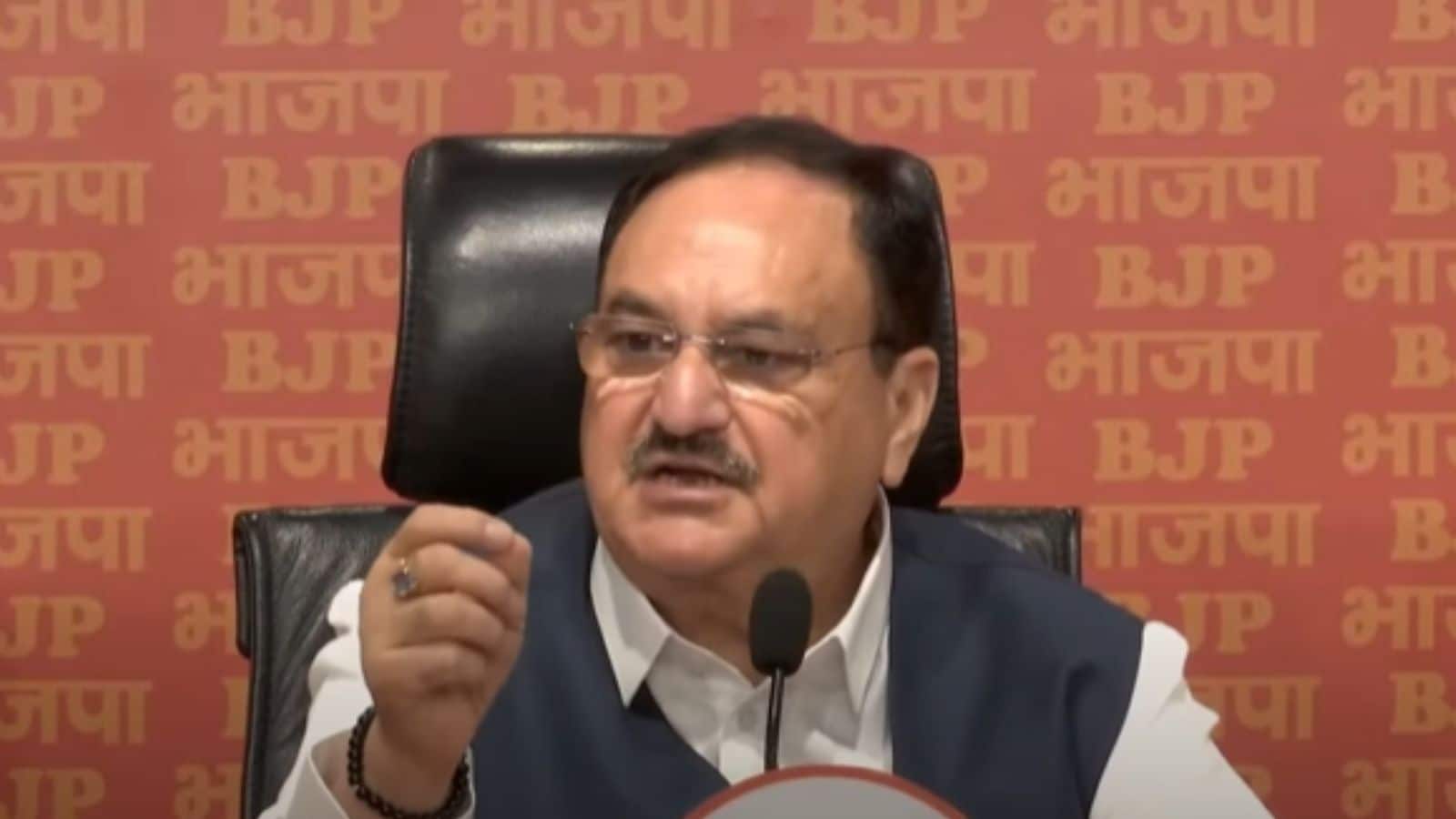
As BJP’s acting president Nitin Nabin prepares to file his nomination on Monday at 2pm—in a competition widely expected to be uncontested—the party is quietly turning a page on the tenure of JP Nadda, one of its most understated but structurally significant national presidents who, after his three-year stint, received an extension for a year till January 2024 and later continued as president until the election of his successor.
Nadda’s presidency was unusual from the very start. He became the first BJP president to complete a full term almost entirely under crisis conditions. Barely weeks into office, the Covid-19 pandemic upended conventional politics, forcing the party to abandon mass mobilisation and rallies. Nadda, who assumed duty on January 20, 2020, had little time to recalibrate. Instead of the usual electoral spectacle, the BJP under Nadda slipped into a mode of crisis management, governance coordination and organisational control, spearheading the Bihar election doing hybrid rallies, maintaining social distancing norms and leveraging the party’s IT support.
Unlike his predecessors, Nadda ran the party largely from the “war room” rather than rally stages. His style consciously deemphasised public-facing politics. Insiders say his focus was on data flow, feedback loops and internal reporting, rather than headline-grabbing interventions. This marked a sharp contrast with earlier presidents who often doubled as the party’s most visible ideological or political face, including his predecessor, home minister Amit Shah. Many general secretaries say he works more like a CEO than a BJP president.
One of the less visible but lasting changes under Nadda was the quiet institutionalisation of performance audits. State presidents and organisation general secretaries began to be assessed through internal report cards—covering electoral outcomes, organisational health and welfare outreach—though these evaluations were rarely discussed publicly.
Nadda also presided over a structural transition within the BJP: from a predominantly cadre-driven party to one increasingly shaped by beneficiary-heavy politics. Under his watch, welfare delivery metrics—linked to central government schemes—started carrying weight comparable to traditional booth-level mobilisation. Party functionaries were increasingly judged not just on cadre strength, but on how effectively government benefits translated into political consolidation, say BJP insiders.
Though the BJP announced large membership drives during his tenure, Nadda introduced stricter verification norms, including digital checks and mobile generated OTPs to curb inflated enrolments. This was a notable departure from earlier drives that prioritised scale over scrutiny.
Another quiet shift was the encouragement of non-political professionals into party structures. Data analysts, legal experts, policy researchers and social media specialists were actively integrated into party cells, reinforcing the BJP’s move towards a more technocratic organisational model.
Despite holding the party’s top post, Nadda maintained a deliberately low media profile. The decision, senior leaders say, was conscious—to avoid personality-centric narratives and keep the spotlight firmly on PMModi-led governance rather than party leadership.
In politically sensitive states like West Bengal and Karnataka, Nadda opted for prolonged status quo and equilibrium to manage factionalism, resisting pressure for dramatic leadership changes. The approach prioritised internal balance over quick fixes.
Perhaps the most striking departure from past BJP presidents was ideological restraint. Unlike LK Advani, Rajnath Singh or Amit Shah, Nadda rarely intervened publicly in ideological debates. He treated the BJP president’s office as a purely organisational and electoral role, not an ideological pulpit—an unusual choice in a party known for strong ideological signalling.
As Nitin Nabin moves towards what is expected to be a smooth, uncontested elevation, Nadda’s legacy stands out not for dramatic moments or sharp rhetoric, but for institution-building in silence—a tenure defined less by speeches and more by putting in a system that demands corporate accountability in a political set up.
January 19, 2026, 09:34 IST
Read More