
Last Updated:
Shiv Sena (UBT) accused Eknath Shinde of dismantling the party founded by the late Balasaheb Thackeray and paving the way for the BJP’s rise in the state’s most powerful civic body



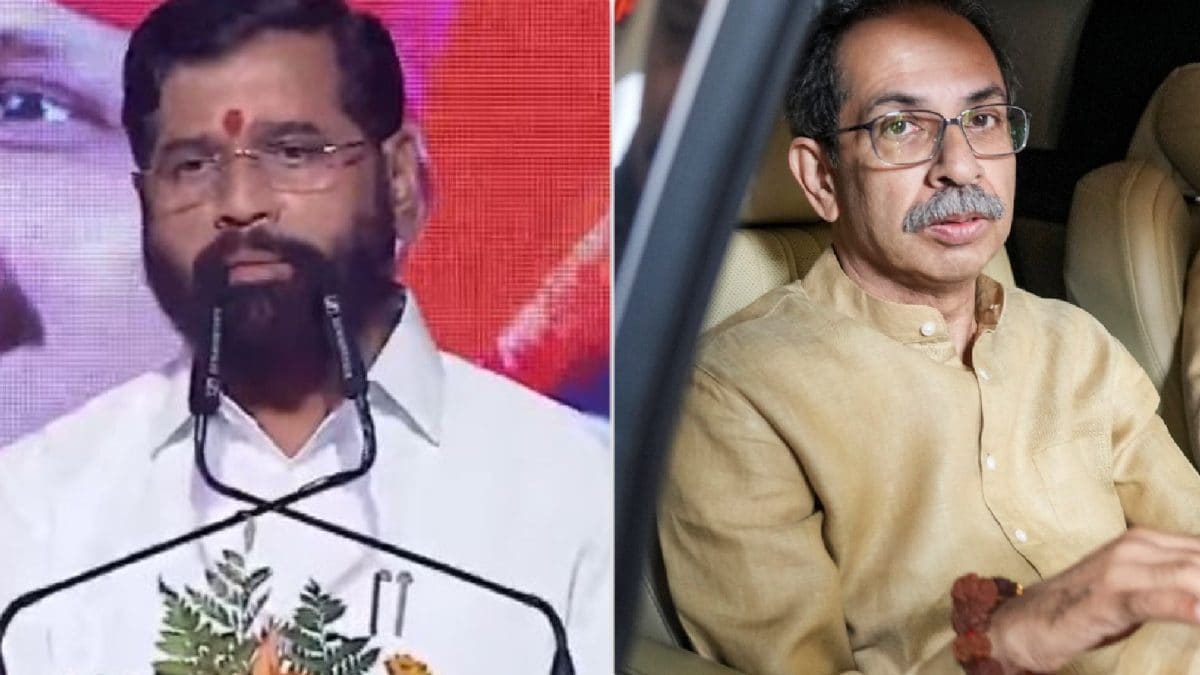
Eknath Shinde (left) and Uddhav Thackeray
The saffron sweep in the Brihanmumbai Municipal Corporation (BMC) elections held on Thursday has engineered a deeply emotional and ideological turn to the battle for Mumbai and opened the doors to yet another Sena vs Sena battle.
Uddhav Thackeray’s Shiv Sena (UBT) on Saturday sharpened its attack on Maharashtra’s deputy chief minister Eknath Shinde, accusing him of dismantling the party founded by the late Balasaheb Thackeray and paving the way for the BJP’s rise in the state’s most powerful civic body.
In a strongly worded statement, Shiv Sena (UBT) leader Akhil Chitre questioned what Shinde and his supporters had actually gained by splitting the party and aligning with the BJP. The statement accused the Shinde faction of becoming partners in a plan to push Shiv Sena out of Mumbai—the city where Balasaheb built the party brick by brick. It alleged that the promise of power and a “luxurious life” came at the cost of Marathi pride, the party’s identity, and its dominance in the financial capital.
The criticism went beyond symbolism. Sena (UBT) leaders pointed out that after breaking the party, its symbol, and its organisation, the Shinde faction could manage to get only 29 corporators elected in BMC despite engineering defections of 56 sitting members. According to the party, this weakened the Shiv Sainik on the ground and opened the doors for a BJP mayor in Mumbai—a first in the city’s political history.
Senior Sena (UBT) leader Sanjay Raut echoed the charge in blunt terms, calling Shinde the “Jaichand of Shiv Sena”. Raut said without Shinde’s rebellion, BJP would never have been able to capture the mayor’s post in Mumbai. “The Marathi people will remember him as Jaichand,” Raut said, invoking the historical symbol of betrayal.
The party had framed the BMC election as more than a civic contest. For Sena (UBT), it was a battle to protect Balasaheb Thackeray’s legacy and the idea of Mumbai as the centre of Marathi asmita. Party leaders say betrayal is not new to this land, recalling that even Chhatrapati Shivaji Maharaj had to fight his own people.
Unfazed by the criticism, Shinde said the people of the state had rejected those who were against development. After the alliance’s victory, the deputy chief minister said: “I want to thank people for choosing development over corruption. The results show that people have accepted Fadnavis and Eknath Shinde’s work. Now, there will be triple engine sarkar to develop Mumbai.”
Taking a dig at the Thackerays for trying to rake up emotional issues such as Marathi pride, Shinde said their parties were fighting for survival and not the Marathis in the state.
“Over the past three and a half years, our alliance government has worked for the development of the city of Mumbai. Whenever the prime minister visits Mumbai, he has said that Mumbai should become an international city. We will make Mumbai pothole-free and corruption-free. We will upgrade Balasaheb Thackeray Aapla Dawakhana,” Shinde said.
The Shiv Sena (UBT) maintains that the decisive factor in the civic battle was the split in its traditional vote base after the party rupture. With Sena votes divided between two factions, the opposition space fragmented, directly benefiting the BJP. Party leaders argue that this division did not reflect a shift in Mumbai’s political mood, but a forced redistribution of loyalties following the rebellion led by Shinde. As a result, the BJP, with the backing of the Shinde-led Shiv Sena, is now set to install its mayor in the Brihanmumbai Municipal Corporation for the first time.
For Sena (UBT), this moment marks not just a political setback, but a historic turning point where internal fracture, rather than public mandate, reshaped Mumbai’s civic power structure. Sena (UBT) insists it will not allow Balasaheb’s ideology or Shiv Sena UBT’s presence to be erased from the city—making it clear that, for them, there will be no compromise, only confrontation.
Speaking to CNN-News18, political analyst Pranay Bhise explained the effect of the Sena vs Sena battle. “The 2026 BMC election was fundamentally defined by the fragmented Shiv Sena, which acted as the primary catalyst for a fractured mandate across the city. My analysis reveals that in 33 crucial wards, the victory of the ruling alliance was not only the result of a development agenda but also a direct consequence of this split and a divided opposition. In these specific seats, the combined vote share of the Shiv Sena (UBT)-MNS alliance and Congress-VBA alliance was significantly higher than the winning candidate’s total. The data reveals that the split in the traditional Sena base, coupled with the four-way division of alternative votes, effectively handed these 33 seats to the BJP-Shinde alliance.”
January 17, 2026, 09:08 IST
Read More