
Last Updated:
In a system where political renewal is often delayed until a crisis, BJP’s choice suggests an effort to normalise leadership succession while retaining ideological continuity

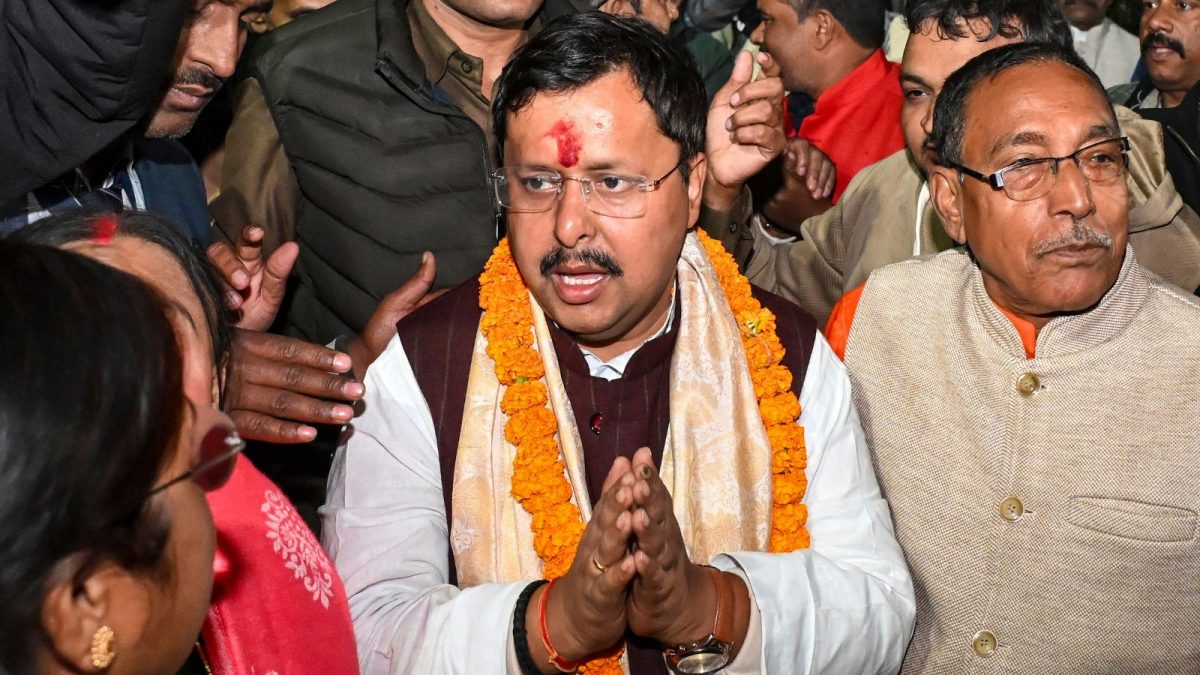
Bihar Minister Nitin Nabin being greeted by supporters after he was appointed BJP’s working national president. (PTI)
Indian political parties often speak the language of generational change, but few practise it meaningfully. Leadership transitions across most major parties remain either hereditary or heavily seniority-driven, resulting in presidents and supremos well past their political prime. Against this entrenched pattern, the Bharatiya Janata Party (BJP)’s elevation of Nitin Nabin as its youngest-ever president at 45 is not merely a generational marker—it is a statement about how the party conceives leadership, succession, and organisational continuity.
A comparison with other political formations shows the difference. Congress president Mallikarjun Kharge is 83, NCP patriarch Sharad Pawar is 85, TMC chief Mamata Banerjee is 70, DMK leader MK Stalin is 72, BSP’s Mayawati is 69, Samajwadi Party chief Akhilesh Yadav is 52, and National Conference leader Omar Abdullah is 55. While age alone does not define political capacity, the dominance of septuagenarians and octogenarians at the helm reflects a broader reluctance across parties to institutionalise a leadership churn. The BJP’s choice, therefore, stands out not as token youthfulness, but as an alternative leadership philosophy.
What makes Nabin’s elevation particularly significant is that it disrupts the often-false binary between youth and experience. At 45, he is not a novice propelled by charisma or lineage, but a leader shaped by electoral endurance and administrative responsibility. A five-time MLA, Nabin’s career has been tested repeatedly at the ballot box—an achievement that lends democratic legitimacy to his rise. His multiple stints as a minister in the Bihar government further demonstrate hands-on experience in governance, policy implementation, and political negotiation.
Equally critical is his deep organisational grounding. With over two decades of active party work, Nabin represents the BJP’s cadre-based leadership pipeline in action. His journey through the Bharatiya Janata Yuva Morcha, including serving as its Bihar president, equipped him with first-hand experience of mobilising youth, managing party workers, and translating ideology into grassroots action. His role as election in-charge in Chhattisgarh expanded this experience beyond state boundaries, exposing him to varied political terrains and electoral strategies.
The regional dimension of his appointment is also politically consequential. As the first BJP president from Bihar—and from eastern India—Nabin’s rise signals a recalibration of the party’s internal power geography. For decades, national leadership has largely emanated from western, northern, or central India. Elevating a leader from the East reflects both the BJP’s expanding footprint in the region and its intent to nurture leadership that mirrors this growth. It also strengthens the party’s connect with states that are increasingly central to national electoral arithmetic.
More broadly, Nabin’s presidency underscores the BJP’s emphasis on institutional leadership rather than personality-centric control. Unlike many parties where presidents function as symbolic extensions of a single family or individual, the BJP’s structure allows for leaders to emerge through organisational performance, electoral success, and ideological commitment. Nabin’s career embodies this pathway—steady, incremental, and merit-based rather than dramatic or dynastic.
In political terms, his rise carries strategic implications. A younger president with substantial organisational experience is better positioned to engage first-time voters, manage an expanding digital political ecosystem, and oversee complex, multi-state election cycles. At the same time, his governance background ensures that the party’s political messaging remains grounded in administrative outcomes rather than abstract rhetoric.
Ultimately, the significance of Nabin’s leadership lies not just in his age but in what his age represents: a generational transition without institutional rupture. In a system where political renewal is often delayed until crisis forces change, the BJP’s choice suggests an effort to normalise leadership succession while retaining ideological continuity. Whether this model reshapes India’s broader political culture remains to be seen, but it undeniably places the BJP in sharp contrast with parties still grappling with the challenge of balancing experience with renewal.
 Click here to add News18 as your preferred news source on Google.
 December 15, 2025, 12:15 IST
Read More