
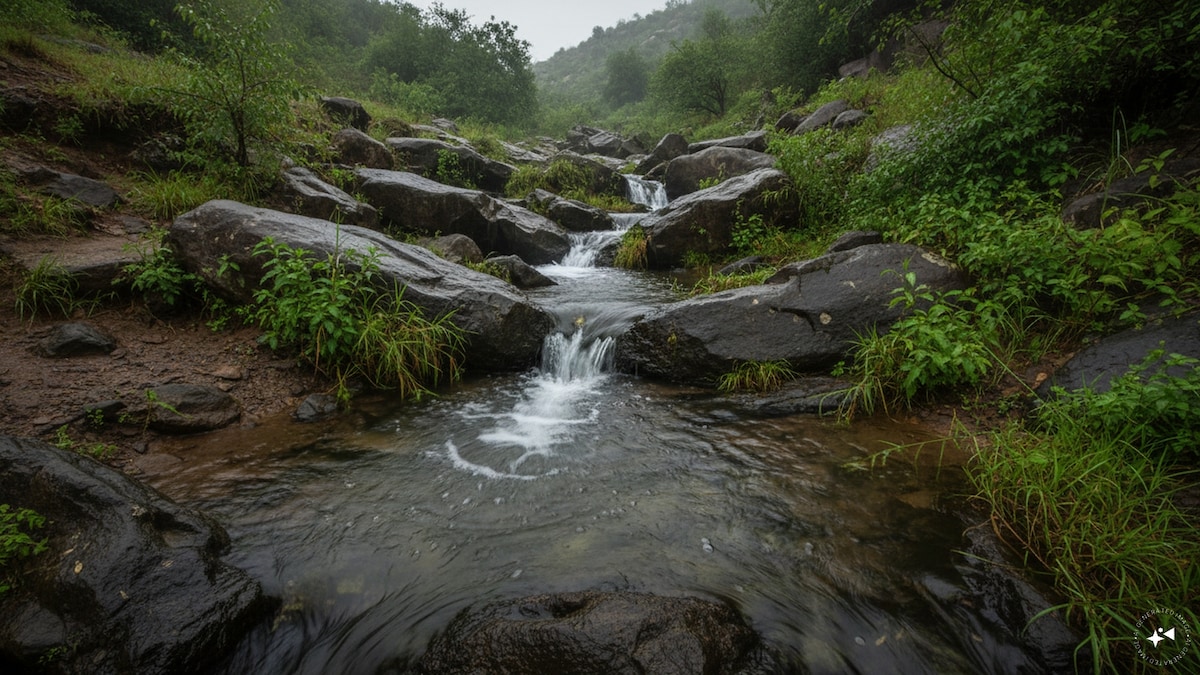
If you are looking to catch this fleeting natural phenomenon, timing is everything. These temporary waterfalls peak within a narrow 12- to 48-hour window following an intense downpour.
Why the Aravallis Cascade After Rain
This sudden transformation is driven by pure geology. The Aravallis are built primarily on ancient quartzite, slate, and crystalline rock—impermeable materials with exceptionally low porosity that absorb very little rainwater.
When a heavy cloudburst drops massive volumes of water in a short span, the thin topsoil reaches immediate saturation. Unable to sink into the hard rock, the surface runoff surges down natural elevation gradients and narrow ravines, converging into rapid streams (nullahs) that drop over rocky cliff faces like temporary waterfalls before quietly drying up as the weather clears.
Top Trails & Cascades to Explore
1. Mangar Bani Valley (Faridabad-Gurugram Border | ~35 km from Central Delhi)
Easily accessible via the Gurgaon-Faridabad highway corridor, Mangar Bani is an ancient, preserved sacred grove filled with native Dhau trees. Its surrounding valley slopes collect heavy catchment water during downpours, channelling runoff into active rocky streams.
2. Leopard Trail & Mandawar Ridge (Gurugram | ~45 km from Central Delhi)
Located roughly an hour’s drive from the city centre, this winding forest stretch is a favourite morning route for cyclists and road trippers. Following intense rain, the surrounding green canopy frames fast-moving runoff streams that surge alongside the road and tumble over stone shelves into natural hollows.
3. Sohna Ridge & Damdama Rim (Gurugram District | ~55 km from Central Delhi)
Traversed via the Sohna Elevated Corridor, the steeper rock faces along this ridge line generate some of the most dramatic elevation drops in the district, producing active seasonal feeder channels that rush toward the Damdama basin.
Know Before You Go: Safety & Eco-Advisory
Avoid Legacy Quarry Pits: The Aravalli belt around Gurugram and Faridabad contains old, abandoned stone-mining pits. Heavy rains fill these unmapped pits quickly, creating deep water bodies with unstable, crumbling edges where swimming or wading is extremely dangerous.
Watch Your Footing: Monsoonal runoff carries loose sediment and slick algae over smooth quartzite rock. Wear sturdy footwear with strong grip and avoid standing directly on wet ledges.
Respect Local Wildlife: The Aravallis serve as an active wildlife corridor home to peacocks, hyenas, and leopards. Keep vehicle noise low, stay on designated paved routes, and carry all trash back with you.
Also Read: Delhi rainy day guide: Where to eat, what to see and how to spend a monsoon day in the capital