
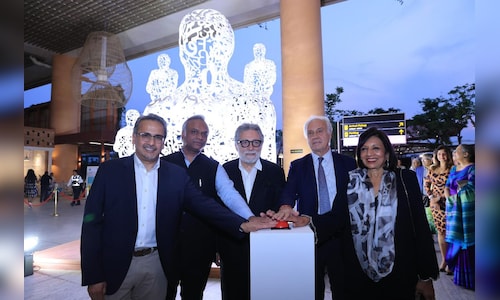
While the installation reflects the city’s cultural identity, it also ties into a broader strategy of enhancing passenger experience to drive engagement.
Speaking to CNBC-TV18, Hari Marar, Managing Director and CEO of Bangalore International Airport Limited, said airports today are designed to offer multiple layers of engagement beyond just ensuring on-time departures.
“The purpose of an airport is not just to make sure people get to their flights on time, but that the journey becomes meaningful,” he said, adding that experiences could range from shopping and dining to engaging with art in a deeper cultural way.
Marar said art can help ease passenger anxiety, a key factor in travel, which may indirectly support higher spending.
“If you eliminate anxiety by calming people down through great works of art, it could potentially lead to better non-aeronautical income, though that is not the primary purpose,” he said.
Non-aero revenue has become a critical profitability lever for airports globally, often contributing a major share of earnings through retail, food and beverage, and other passenger services.
India’s infrastructure policy also provides for art investments. Government norms require large infrastructure projects to allocate around 1% of project cost towards art. For a ₹10,000 crore project, this translates to a ₹100 crore outlay, underlining the scale at which such programmes operate.
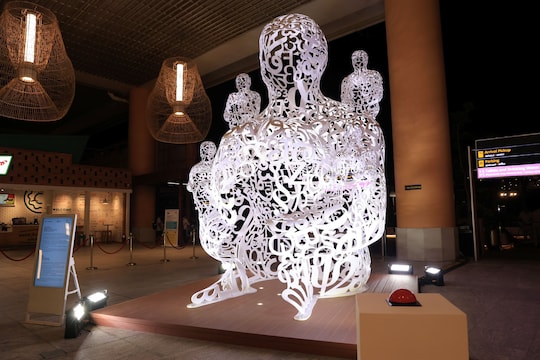
At Bengaluru airport, the art programme is designed as a mix of established and emerging artists, with contributions from institutions including the Karnataka government, alongside corporate support from the Biocon Foundation.
Kiran Mazumdar-Shaw, Chairperson of Biocon, said public art plays a role in shaping more liveable and culturally vibrant urban spaces.
The installation also comes as airports globally compete on passenger experience and branding, with art, architecture and design emerging as key differentiators.
Bengaluru airport has climbed to fifth place in Skytrax’s World’s Best Art in the Airport rankings in 2026.
Plensa, known for large-scale public works across cities such as Chicago, London and Tokyo, described airports as symbolic spaces of connection.
“An airport is the border, the link of one place with the world,” he said, adding that the installation uses language as a metaphor for identity and human connection.
For airport operators, however, the bet is more pragmatic: while art may not directly drive sales, it is increasingly seen as part of a broader strategy to enhance dwell time, improve passenger comfort and support non-aeronautical revenue over time.