
 1 / 8
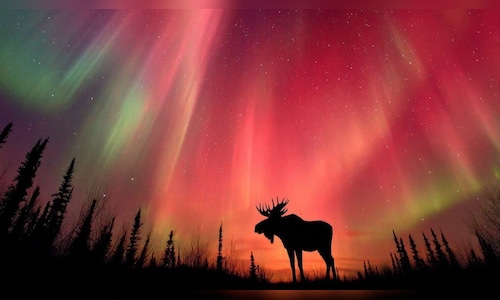
1 / 8On the night of January 19–20, a severe G4 geomagnetic storm triggered spectacular displays of the Northern Lights (Aurora Borealis) across several regions. The event was a result of a powerful X1.9-class solar flare on January 18, which launched a massive coronal mass ejection (CME) directly toward Earth. (Image X@ Rongelukas)
 2 / 8
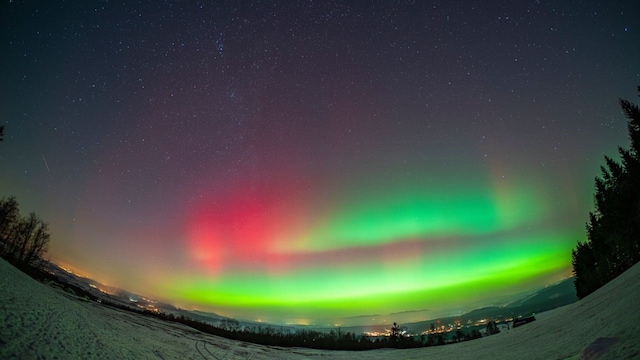
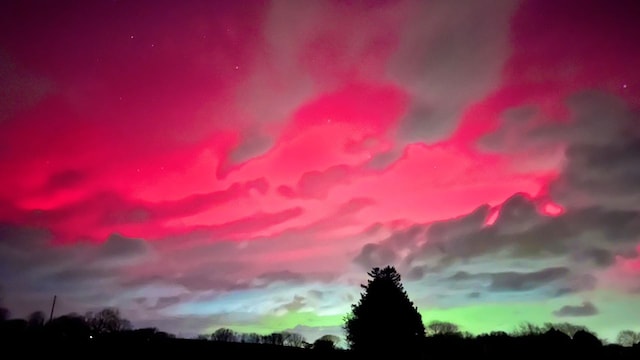
2 / 8Due to the storm’s intensity, sightings were reported across Europe, with reds and greens visible in China, Scandinavia, the United Kingdom, and throughout Europe, from Germany and France to Hungary. Although the display was intense enough to be visible as far south as Arizona, Texas, and southern California, geomagnetic activity had subsided by the time darkness fell over North America. (Image X)
 3 / 8
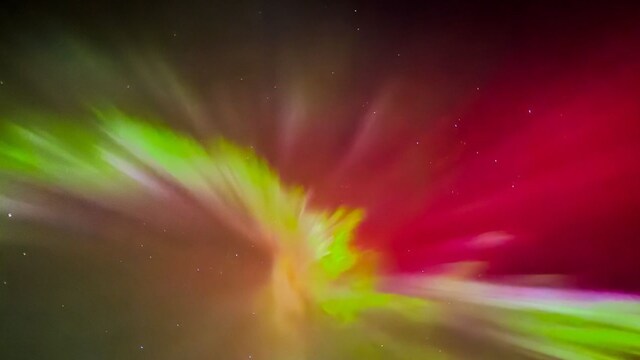
3 / 8Reports and photos filled social media from locations that rarely experience such phenomena, including southern Europe and other lower-latitude areas. The National Weather Service’s Space Weather Prediction Center earlier issued a warning for a level four out of five solar radiation storm, the largest in over 20 years. (Image X)
 4 / 8
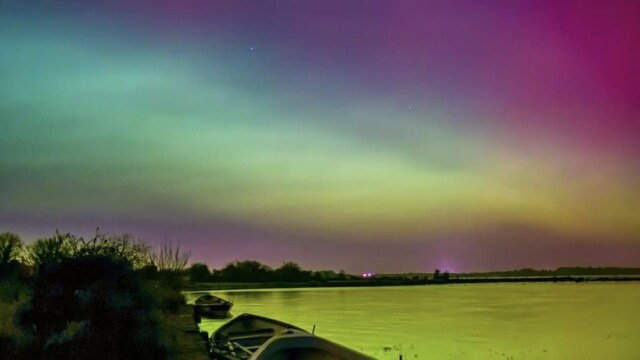
4 / 8The storm could disrupt satellite-based communications and GPS accuracy, and pose radiation risks to astronauts and passengers on flights that are travelling polar routes. The center notified airlines, NASA, the Federal Aviation Administration, the Federal Emergency Management Agency, the North American Electric Reliability Corporation, and other operators to prepare for the storm. (Image X@Galwaytourism)
 5 / 8
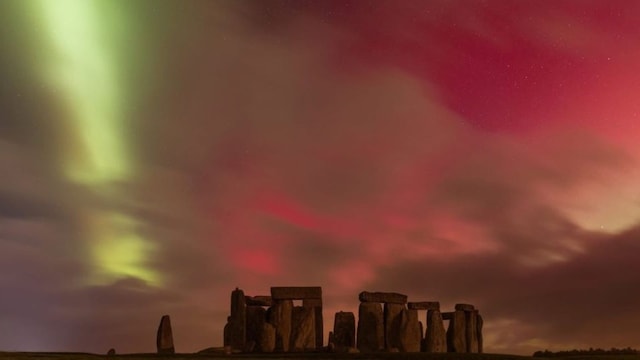
5 / 8“We’ve been making all these phone calls to ensure that we are keeping all the critical technological infrastructure operators in the know of what’s happening,” SWPC forecaster Shawn Dahl was quoted as saying by CNN. According to Dahl, a severe geomagnetic storm also reached Earth on Monday, which could disrupt the electric power grid. The storm is caused by a coronal mass ejection launched from the sun on Sunday, triggered by an X-class flare. (Image X@St0nehenge)
 6 / 8
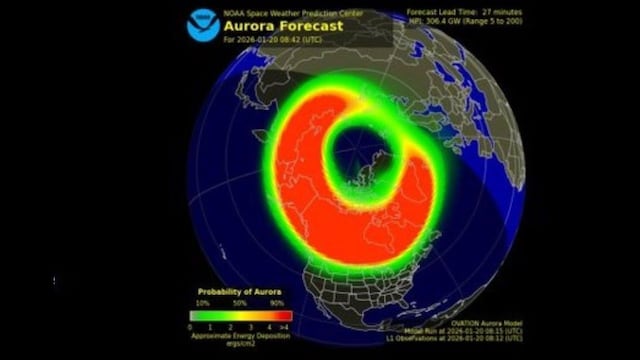
6 / 8According to the NOAA aurora forecast map, the 24 US states are wholly or partially above the aurora view line: Alaska, Washington, Oregon, Idaho, Montana, North Dakota, Minnesota, South Dakota, Wisconsin, Wyoming, Michigan, New York, Vermont, Maine, New Hampshire, Massachusetts, Nebraska, Iowa, Illinois, Indiana, Ohio, Pennsylvania, Missouri and Colorado. (Image X)
 7 / 8
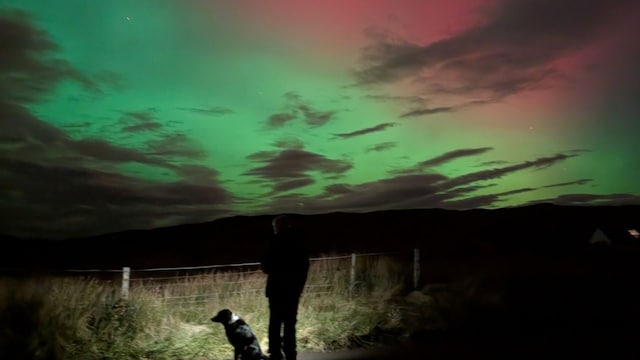
7 / 8To spot the auroras, find a location with a clear and dark view north, without light pollution. Cameras, including cellphone cameras, can pick up the displays even if they’re not visible to the naked eye. The active sunspot region is likely to produce further Earth-directed eruptions, with more flares possible in the next week. (Image X)
 8 / 8
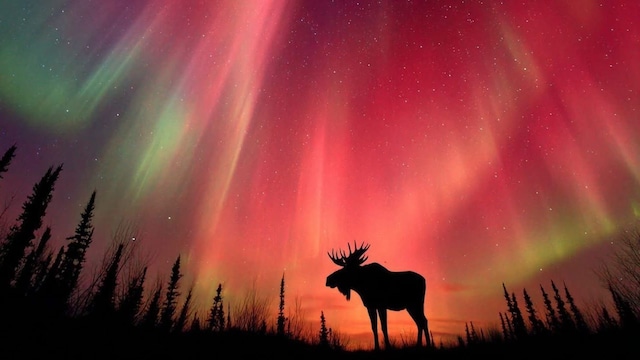
8 / 8Because the S4 solar radiation storm is currently in progress, it might be necessary to reroute flights over the poles or fly at lower altitudes, according to MyRadar Weather. “For the first time since 2003, an S4 solar radiation storm is ongoing! Solar particles and protons accelerated by an approaching magnetic shockwave (CME) are bombarding Earth. The more of those energised particles, the deeper into our upper atmosphere they can burrow,” it wrote on X. (Image X@forallcurious)