

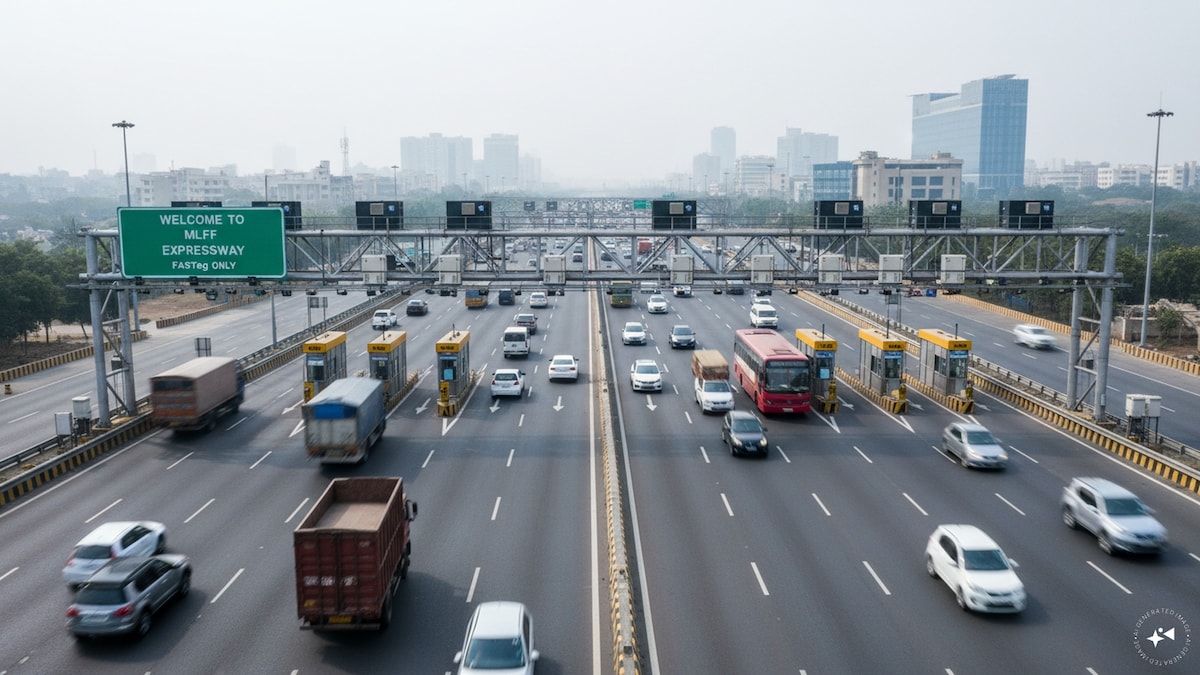
Delhi is preparing to introduce a barrier-free toll collection system at its major entry points, allowing vehicles to pass through without stopping at conventional toll booths.
The Municipal Corporation of Delhi (MCD) is installing a Multi-Lane Free Flow (MLFF) system that will use FASTag readers, number plate recognition cameras and sensors to identify vehicles and collect applicable charges electronically.
The move is aimed at reducing traffic congestion at Delhi’s border entry points, cutting waiting times and lowering fuel consumption and vehicular emissions. The system is expected to be particularly useful during morning and evening rush hours, when long queues often build up at toll plazas.
The MCD’s first phase will cover 20 major toll locations, which account for around 85% of the traffic entering the national capital. Ghazipur, Rajokri, Badarpur, Dwarka, Aya Nagar and the Delhi-Gurugram corridor are among the locations identified for the rollout.
The civic body operates 154 toll collection points across Delhi, with the remaining locations expected to be covered in subsequent phases.
However, the rollout has been delayed. The MCD had initially set October 31, 2026, as the deadline for making the system operational at major locations. The deadline was missed, and trial runs were planned at Ghazipur and other locations in early November to test the equipment before activation.
Amitabh Bachchan, MCD toll shift in-charge, told NDTV that the system would benefit vehicles entering Delhi, particularly during peak hours, as they would no longer need to stop at toll booths.
How it works
The MLFF system will allow vehicles to pass through toll points without stopping to make payments or wait for a barrier to open. Instead of conventional toll booths, electronic equipment will be installed on overhead structures called gantries.
The system will use three main technologies:
FASTag readers: Radio Frequency Identification (RFID) readers will scan the FASTag attached to vehicles as they pass beneath the gantries.
Number plate cameras: Automatic Number Plate Recognition (ANPR) cameras will capture vehicle registration numbers to identify vehicles and verify toll transactions.
Sensors and surveillance cameras: These will detect vehicles, monitor their movement and support the electronic toll collection process.
Once a vehicle is identified, the system will match its details with the applicable vehicle category and process the relevant toll payment electronically.
Unlike conventional toll collection, where vehicles may have to slow down or stop for checks and payments, MLFF is designed to process transactions while vehicles remain in motion. The system will also integrate with the MCD’s existing RFID-based toll collection infrastructure.
The technology builds on the FASTag ecosystem and does not mean toll charges will be abolished. It changes the way vehicles are identified and payments are collected.
Who pays toll
The introduction of MLFF does not mean every vehicle entering Delhi will automatically have to pay the MCD’s entry toll.
The MCD collects toll charges from commercial vehicles entering the national capital. The applicable charges depend on the vehicle category and existing toll rules. Private car users are not automatically liable for this commercial vehicle entry toll, although they could benefit from shorter queues and smoother traffic movement.
The MCD also collects the Environment Compensation Charge (ECC) at its entry points under the applicable arrangements. The new electronic infrastructure is expected to facilitate the digital collection of applicable charges.
What if FASTag has low balance
Motorists will need to maintain sufficient balance in their FASTag accounts to avoid payment-related issues.
Under the NHAI’s existing MLFF framework, vehicles with insufficient FASTag balance, invalid tags or non-functional tags can receive an Electronic Notice (E-Notice) for non-payment of the applicable toll.
The NHAI’s prescribed rules provide a 72-hour window to pay the normal toll fee after receiving the notice. If payment is not made within this period, the payable amount increases to twice the normal user fee for the vehicle category.
Vehicle owners who believe an E-Notice has been issued incorrectly can also raise a grievance through the designated portal within 72 hours.
Non-payment of such notices may lead to FASTag blacklisting and restrictions on certain vehicle-related services through the VAHAN platform.
However, these provisions relate to the NHAI’s MLFF framework. The MCD’s specific rules for payment defaults, digital notices and penalties will need to be checked once its border toll system becomes operational.
When will it start
The MCD’s barrier-free toll project has missed its original October 31, 2026, deadline. Installation work was still underway at several major locations in early November, with trial runs planned to verify the accuracy of the new equipment.
As of November 24, trials had begun at several locations, and the project was expected to be completed soon. The initial rollout will cover 20 major entry points before the system is extended to the remaining locations.
The project is part of a wider shift towards automated toll collection in India. The NHAI introduced an MLFF-based system at the Chorayasi Toll Plaza on the Surat-Bharuch section of National Highway 48 in Gujarat in May 2026. The technology has also been introduced at locations such as the Mundka-Bakkarwala toll plaza on Delhi’s Urban Extension Road-II.
These NHAI installations are separate from the MCD’s project covering municipal border toll points.
For Delhi, the proposed system is expected to replace the need for vehicles to stop at physical toll booths, making electronic toll collection possible while traffic continues moving.
Delhi’s 20 busiest entry points to get barrier-free tolls: What changes for motorists