
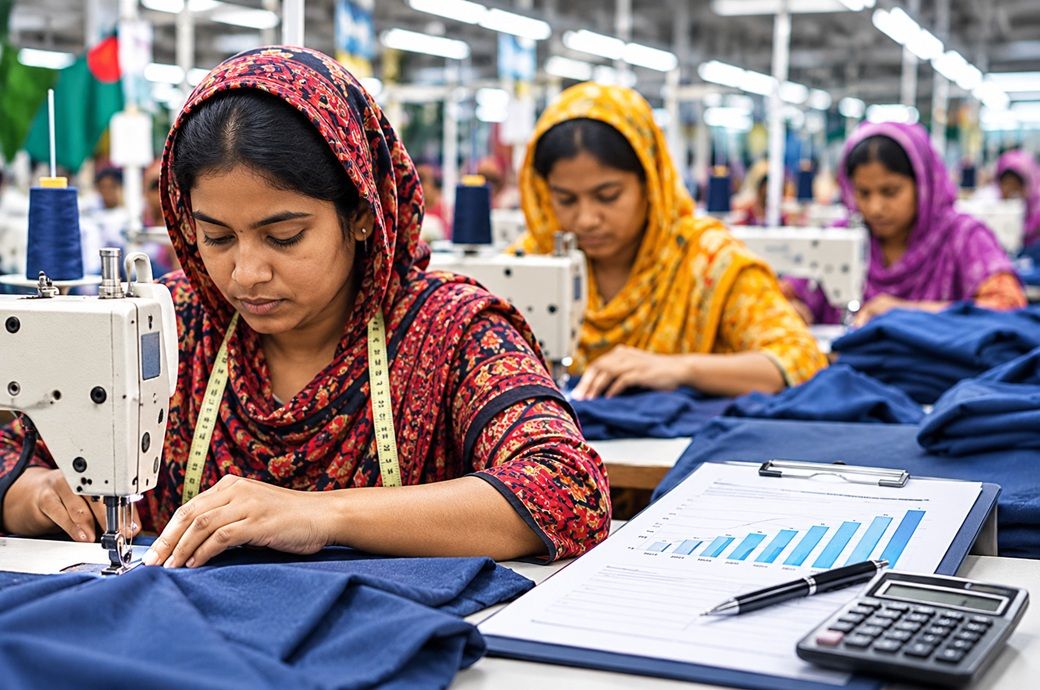
CPD said garment workers now require Tk16,351 (~$131) to purchase the same goods and services that Tk12,500 (~$100) could buy when the current minimum wage was fixed in 2023. An inflation-only adjustment would therefore maintain purchasing power but would not raise real income, according to the think tank.
Bangladesh’s CPD has proposed a monthly minimum wage of Tk18,578 (~$149) to Tk24,204 (~$195) for RMG workers, ahead of a new wage due on December 1.
Its benchmarks cover inflation, the urban Dhaka poverty line and a living-wage basket for a four-member household with 1.58 earners.
The wage board meets on November 23; workers seek Tk32,000 (~$257), while owners have not filed a proposal.
The estimates were presented by CPD executive director Nazneen Ahmed at a press conference titled Determining the Minimum Wage in the RMG Sector at the think tank’s Dhanmondi office in Dhaka on November 18. CPD distinguished fellows Dr Debapriya Bhattacharya and Professor Mustafizur Rahman, and head of research Towfiqul Islam Khan, also attended the event, local media reported.
Using available secondary data, CPD set out three wage benchmarks. The first adjusted the current entry-level wage of Tk12,500 (~$100) for a 30.8 per cent rise in urban prices, giving a present equivalent of Tk16,351 (~$131). The second, based on the upper poverty line in urban Dhaka, put the monthly wage at Tk18,578 (~$149) per earner for a four-member household to remain above the poverty threshold. The third, based on a living-wage basket covering food, housing, other essentials and emergency savings, was calculated at Tk24,204 (~$195) per earner.
The calculations assume a four-member household with 1.58 earners. CPD cautioned that the figures are indicative because there is no large, representative survey of RMG workers.
The proposal comes as the six-member Minimum Wage Board, formed on November 1, has not reached a decision. Workers’ representatives demanded an entry-level wage of Tk32,000 (~$257) on November 9, while factory owners have not submitted their proposal. The board’s third meeting, postponed on November 16, has been rescheduled for November 23. The new wage is scheduled to take effect on December 1, with payment beginning from January 2027 salaries.
During CPD consultations on November 11 and 12, factory owners cited higher energy and borrowing costs and lower export prices as major constraints on their ability to absorb wage increases. Workers called for pay sufficient to cover food, housing, healthcare and education. CPD said both sides supported annual wage adjustments under a fixed formula.
The think tank also warned that living wages are increasingly becoming a market-access issue. From 2029, major European Union buyers will be required to check whether workers in their supply chains receive an adequate living wage. CPD said continued duty-free access under GSP+ after 2032 will also depend on compliance with labour standards.
Bangladesh earned $48 billion from exports in FY26, with the RMG sector accounting for 81 per cent of the total.
Fibre2Fashion News Desk (CG)