
While such cases may not reflect the broader industry experience, they nonetheless highlight an important question about how risks are shared between suppliers and buyers.
A recent circular from the Bangladesh Knitwear Manufacturers and Exporters Association (BKMEA), highlighted in media reports, brought the issue to the fore. The association reportedly cautioned its members against dealing incautiously with more than a dozen entities, including overseas buyers, buying houses and intermediaries, following complaints involving unpaid export bills, failure to take delivery of goods, shipment delays and alleged contractual violations.
Bangladesh garment exporters face renewed payment-risk concerns after BKMEA reportedly warned members about more than a dozen entities.
Six factories’ seven complaints involved about $2.34 million, citing unpaid bills, delivery failures, shipment delays and alleged contractual violations.
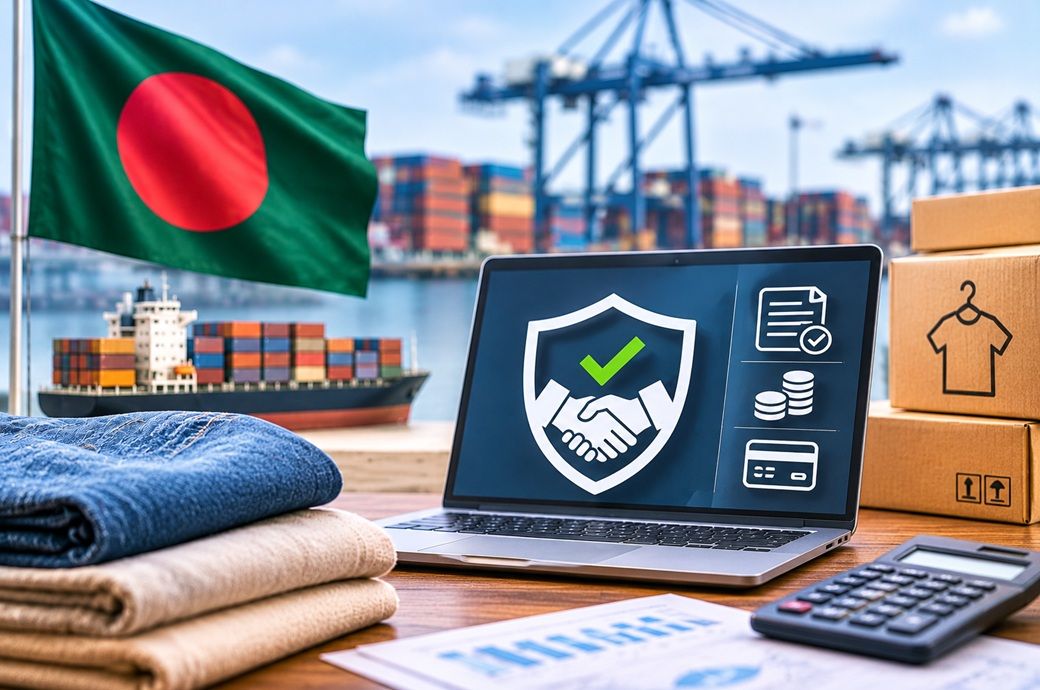
The cases underline the need for due diligence, clear contracts and bank-backed, lawful payment safeguards.
According to media reports, seven complaints from six factories involved approximately $2.34 million. The association also reportedly highlighted concerns that intermediaries could evade accountability when their obligations were not clearly specified in commercial documents.
For an industry that drives Bangladesh’s merchandise exports and sustains millions of livelihoods, even a delay in payment can have consequences far beyond a single transaction. Factories finance raw materials, production, wages, and utilities long before export proceeds arrive. When payments are delayed or remain unsettled, working capital gets tied up, bank obligations mount, and manufacturers’ ability to take on fresh orders comes under strain.
What begins as a buyer’s payment delay can quickly become a manufacturer’s cash-flow crisis, putting jobs and the wider supply chain under stress. With margins already thin, garment makers have little room to absorb the cost of delayed payments.
The latest warning is not an isolated episode. Similar payment disputes have surfaced in recent years. In March 2026, the Bangladesh Garment Manufacturers and Exporters Association (BGMEA), according to media reports, cautioned its members about a US-based sourcing company following a Bangladeshi exporter’s complaint over unpaid dues for a large shipment of garments.
In another reported dispute in 2026, Bangladeshi garment factories and buying houses reportedly raised substantial payment claims in connection with cross-border sourcing arrangements involving a European fashion retailer and a Russian intermediary. The case highlighted the complexities that can arise in multi-party commercial arrangements, particularly when questions emerge over contractual responsibilities and payment obligations.
Subsequent media reports indicated that the retailer had agreed to facilitate discussions towards resolving the dispute, while maintaining that it was not legally obliged to settle the claims itself.
Earlier, in May 2025, BKMEA reportedly said that 14 exporters were struggling to repatriate payments from transactions involving Russian buyers, partly because of sanctions-related payment restrictions. Before that, in October 2024, exporters had also reportedly sought to recover substantial outstanding payments from an Australian retail group.
These cases differ in their circumstances. Not every payment delay indicates bad faith. Sanctions, banking restrictions, insolvency, quality disputes, and genuine contractual disagreements can also complicate things. Industry insiders have emphasised that these distinctions make due diligence, transparent contracts and enforceable payment safeguards particularly important.
Exporters cannot afford to treat an order as secure merely because it comes through an established intermediary or promises substantial volumes.
Experts also emphasised that exporters should assess prospective buyers’ financial standing, payment history and business credentials before accepting sizeable orders. They should establish the legal identity of intermediaries, clearly define their responsibilities, and negotiate advance payments, letters of credit or appropriate bank-backed payment undertakings wherever commercially feasible.
Trade credit insurance and factoring may also help exporters manage their exposure, depending on eligibility, cost and coverage.
Written agreements should also specify payment deadlines, delivery and acceptance conditions, responsibility for payment, applicable law and dispute-resolution procedures. Exporters and their banks should additionally verify that proposed payment channels are lawful and operational, particularly when transactions involve markets affected by sanctions or banking restrictions.
Industry associations could strengthen confidential information-sharing on reported defaults, while verifying allegations and allowing affected parties to respond. Banks, insurers, and regulators could also work with exporters to improve awareness of available safeguards and address barriers to their use.
Bangladesh’s garment industry, which has earned its place in global markets through reliability and resilience, cannot afford to let payment issues become the hidden cost of its global competitiveness. Ultimately, as stakeholders have pointed out, the answer lies not in treating every dispute as misconduct, but in building a trading environment where risks are assessed upfront, responsibilities are clearly defined and legitimate dues can be recovered without costly, protracted battles.
Fibre2Fashion News Desk (DR)