
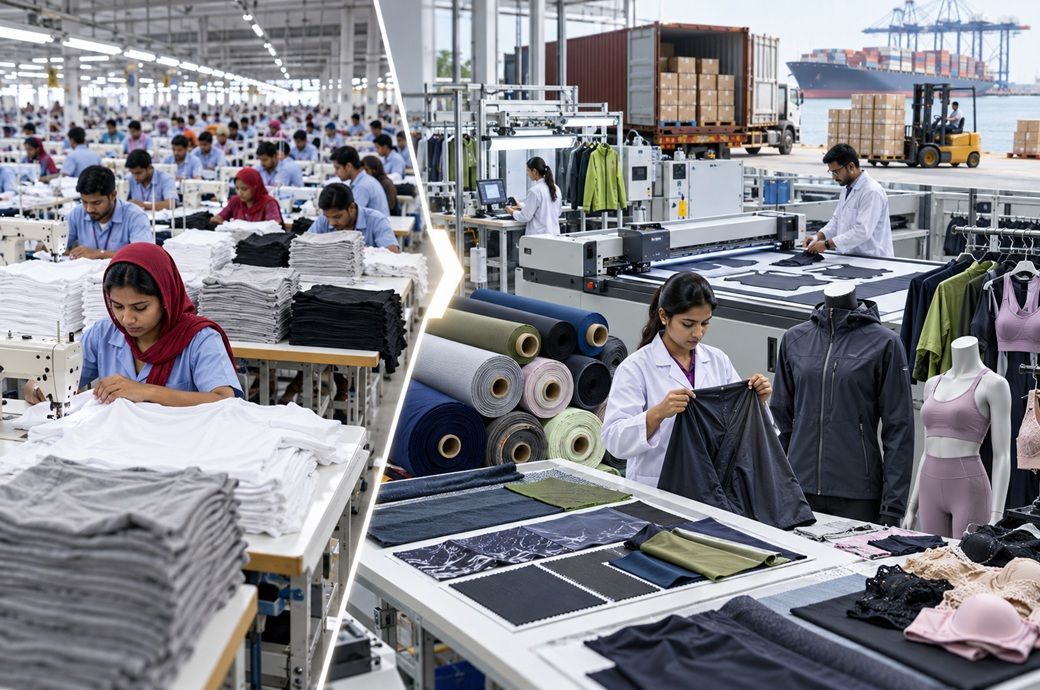
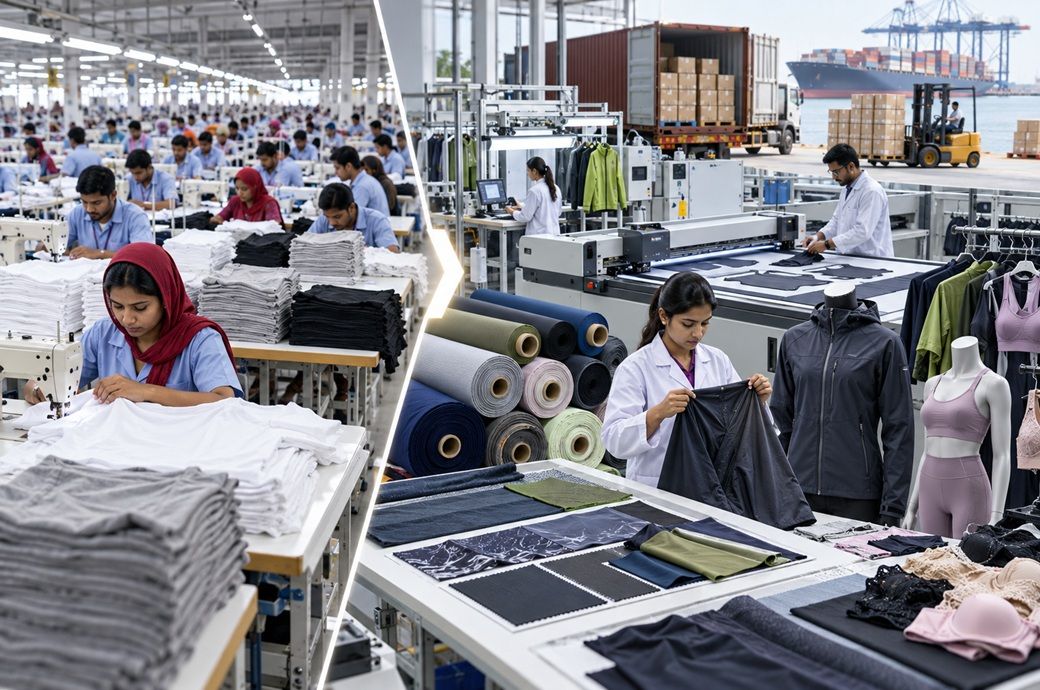
Bangladesh exported an estimated $38.825 billion worth of apparel in calendar year 2025. Media reports, citing certain analysis based on data from the Export Promotion Bureau and the International Trade Centre’s Trade Map, meanwhile highlighted that 76.94 per cent of Bangladesh’s apparel export basket came from basic categories, compared with 61.58 per cent globally.
The analysis classified products such as bottomwear, T-shirts and sweaters, among others, within its basic-product category.
Bangladesh exported an estimated $38.825 billion worth of apparel in 2025, but 76.94 per cent of its export basket came from basic categories.
A September 2026 amendment to the Import Policy Order 2026–2029 has eased access to specialised fabrics for specified apparel categories.
The change could support sportswear, functional apparel, MMF-based products and wider product diversification.
A September 2026 amendment to Bangladesh’s Import Policy Order 2026–2029, meanwhile, has eased access to specialised fabrics and materials for specified apparel categories, including seamless sportswear and functional garments, subject to the conditions set out in the amended provisions and, where applicable, recommendations from Bangladesh Garment Manufacturers and Exporters Association (BGMEA) or Bangladesh Knitwear Manufacturers and Exporters Association (BKMEA), as per recent reports.
The amendment has also reportedly removed the requirement for export-oriented garment manufacturers to obtain Commerce Ministry permission to import yarn and fabric. This change should be distinguished from the specialised-fabric provision: the former reduces procedural requirements in specified cases, while the latter provides a framework for importing specialised inputs for certain apparel products.
Crucially, the significance of the change lies primarily in easing import procedures and sourcing restrictions rather than in reducing import duties. Its immediate significance, therefore, lies in greater sourcing flexibility. That matters because specialised and higher-value apparel may require inputs that are not available domestically at the required cost, quality, scale or speed.
Bangladesh’s heavy concentration in cotton-based apparel can constrain its ability to compete in product categories that require a broader range of synthetic, blended and functional textile inputs. Easier access to specialised materials could help manufacturers respond more effectively to changing requirements and develop products in segments such as sportswear, functional apparel and other technically demanding categories.
The industry has been making a similar case for some time now. The BGMEA has repeatedly highlighted product and market diversification. It has also emphasised technology adoption, skills development, product development and innovation as important elements of the industry’s next phase of growth.
There is also growing industry interest in categories such as sportswear, outerwear and technical apparel. BGMEA has highlighted investments and factory-level initiatives involving higher-value and non-cotton products, while industry programmes have focused on strengthening capabilities in MMF-based apparel and product development.
But easier access to imported inputs is not enough to transform Bangladesh’s product mix. Moving into more sophisticated, high-value products also requires investment in machinery, technical skills, manufacturing capabilities, and related areas. Many therefore see the policy change as removing one of the constraints to this transition.
That distinction matters. Easier access to a wider range of fabrics can give manufacturers more room to develop and scale specialised products. But turning that flexibility into a lasting competitive advantage will depend on whether the industry can build the capabilities needed to compete not just on volume, but increasingly on value.
Fibre2Fashion News Desk (DR)