
Businesses that rely heavily on LPG for daily cooking are facing rising costs and irregular supply, with reports of long queues and black-market sales at inflated prices.
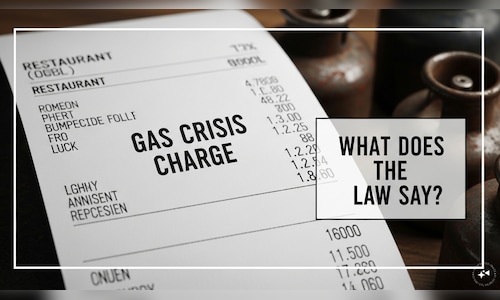
In this backdrop, a Bengaluru cafe’s bill for a lemonade recently went viral on social media. The bill included a 5% ‘gas crisis charge’ after a discount, adding ₹17.01 to the total. With GST applied, the final amount reached ₹374. Users online reacted sharply, with some questioning the use of gas in making lemonade while others termed it exploitative.
Restaurant operators say that higher LPG prices are straining operations. Similar instances have reportedly emerged in Chennai, Gurugram and other cities, where customers were charged an additional ₹9 to ₹30 on items such as idli, vada and momos, News18 Hindi reported.
Is ‘gas charge’ legally allowed?
As per provisions under the Consumer Protection Act, 2019, and guidelines issued by the Central Consumer Protection Authority (CCPA), restaurants are permitted to charge only the listed price of food and applicable GST.
Also Read: Iran-US-Israel War Live Update
Service charges are not mandatory and must be optional, meaning customers can refuse to pay them.
While there is no special provision regarding restaurants and hotels imposing a ‘gas crisis charge’ or ‘LPG charge’, However, adding these could be considered an unfair and hidden cost.
Authorities have clarified that no additional fee can be imposed by default or without customer consent. If establishments wish to offset rising input costs, they are required to revise menu prices transparently rather than introducing separate line-item charges, as per News18 Hindi.
What does the law say about unfair trade?
The Consumer Protection Act, 2019 defines “unfair trade practice” as a practice which “adopts any unfair method or unfair or deceptive practice” for the purpose of promoting the sale, use or supply of any goods or for the provision of any service.
Section 2 (47) lists out various cases to describe the unfair trade practice. These practices include making any statement, whether orally or in writing or by visible representation including by means of electronic record, which falsely represents that the goods or services are of a particular standard, quality, quantity, grade, composition, style or model.
Falsely representing any re-built, second-hand, renovated, reconditioned or old goods as new goods is also not allowed. Similarly, claiming that the goods or services have sponsorship or approval or affiliation is also considered as an unfair trade practice.
Also Read: LPG consumption slumps 17% in March on war-related shortages
Making a false or misleading representation concerning the need
for, or the usefulness of, any goods or services; and giving to the public any warranty or guarantee of the performance, efficacy or length of life of a product or of any goods that is not based on an adequate or proper test thereof also falls under unfair trade practice.
If such cases are filed, the onus would be on the defending party to prove that such warranty or guarantee is based on adequate or proper test.
How can consumers raise complaints?
Consumer rights experts advise customers to retain a copy of the bill and report such practices. Complaints can be filed via the National Consumer Helpline (NCH) by dialling 1915 or toll free number 1800-11-4000.
Consumers can also file a complaint through the NCH mobile app, or by visiting the official portal at www.consumerhelpline.gov.in. The CCPA also provides an SMS number 8800001915 to help consumers raise complaints.
The CCPA can investigate such cases and impose penalties of up to ₹50,000 or order refunds if violations are found, as per News18 Hindi.
Also Read: LPG Aadhaar eKYC rule: Only unauthenticated users required to complete process, clarifies government