
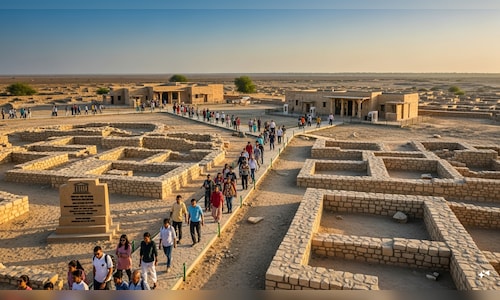
According to Bhavik Sheth, Chief Operating Officer at Evoke Experiences, the site receives around 1.5 lakh visitors annually on average, though numbers fluctuated during the pandemic years.
He said the UNESCO inscription has significantly increased the site’s national and international visibility.
“Post-recognition, there has been a steady rise in heritage-driven tourism, academic visits, and culturally motivated domestic travel,” Sheth said.
He added that the visitor mix has evolved from largely regional tourists to a broader profile that includes researchers, curated travel groups and experiential travellers.
Policy direction announced in the Union Budget 2026 is also expected to influence the site’s tourism trajectory.
Finance Minister Nirmala Sitharaman proposed developing 15 archaeological sites, including Lothal, Rakhigarhi, Sarnath, Hastinapur and Leh Palace, as “vibrant experiential cultural destinations.”
While detailed project-level allocations for individual sites have not yet been specified, Sheth said the proposal reflects a shift towards experience-led heritage tourism.
“The plan includes opening excavated landscapes to the public through curated walkways, immersive storytelling, and the introduction of conservation technologies, interpretation centres and trained guides,” he said.
Tourism at Dholavira remains largely seasonal due to climatic conditions in the Kutch region. Sheth said most visitors arrive between November and February, with March and October acting as shoulder months, while footfall declines between April and September because of high temperatures.
Efforts to position the site as a year-round destination are therefore focused on improving infrastructure and expanding the range of visitor experiences.
“Infrastructure investments such as improved access roads, shaded pathways, and enhanced onsite facilities are designed to improve comfort beyond winter,” Sheth said.
He added that initiatives such as heritage interpretation programmes, school and research tourism, desert ecology experiences and curated cultural activities aim to broaden visitation across seasons.
Tourism linked to the site also contributes to local economic activity in the surrounding Kutch region. Sheth said visitor spending supports accommodation providers, transport operators, local guides, food establishments and handicraft sellers, while also generating indirect employment through local supply chains and small enterprises.
At the same time, the surrounding salt plains and the white desert landscape of the Great Rann of Kutch remain key attractions for travellers.
Sheth noted that these ecosystems are fragile and require careful management, with responsible tourism practices such as regulated access routes and controlled visitor movement needed to protect the environment while supporting tourism growth.