
The shortage has emerged as supply chains for LPG imports face disruption following geopolitical tensions in West Asia. The situation has prompted industry bodies to warn of operational challenges for restaurants and hotels that depend heavily on commercial LPG cylinders.
What has caused the LPG shortage?
The supply disruption follows military strikes by the United States and Israel on Iran and Tehran’s subsequent retaliation, which led to the closure of the Strait of Hormuz.
The waterway is a key route for India’s energy imports.
Around 85–90% of India’s LPG imports from West Asia, including supplies from Saudi Arabia and Qatar, pass through the strait.
The shortage has been reported in several cities including Mumbai, Bengaluru, Kolkata and Chennai.
The government has moved to prevent hoarding and black marketing during the supply disruption.
The Centre invoked the Essential Commodities Act, 1955, which allows authorities to regulate the production, supply, distribution and trade of commodities declared essential.
According to the Ministry of Petroleum and Natural Gas, booking demand for LPG cylinders rose to around 75.7 lakh compared with an average of 55.7 lakh before the conflict, indicating panic bookings in some areas.
Officials have urged consumers not to panic, stating that there is no “dry-out at any LPG dealer”.
Why the hospitality sector is affected
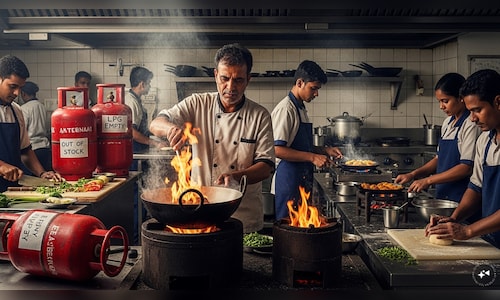
Restaurants and hotels rely largely on commercial LPG cylinders for daily cooking operations. Industry representatives say shortages can quickly disrupt kitchen operations.
“Restaurant and hotel kitchens rely heavily on LPG for their operations, and any supply shortages or price hikes could disrupt their functioning across the country,” said K B Kachru, President of the Hotel Association of India and Chairman – South Asia, Radisson Hotel Group.
“Such disruptions pose a threat to industry as many small & medium-sized size establishments may be constrained to temporarily shut down on account of continued shortage of LPG causing hardships to all concerned,” he added.
In Thane, industry representatives said more than 800 hotels and restaurants could face shutdown if supplies are not restored soon.
“Many hotels currently have gas stock for only five to six days. If the supply is not restored immediately, closures may become unavoidable,” said Raghunath Shetty, secretary of the Thane City Hotel Association.
“Some vendors are charging an extra ₹400 per cylinder in the black market,” alleged Ratnakar Shetty, vice president of the association.
How restaurants and hotels are coping
With supplies tightening, several restaurants and hotels are adjusting operations to conserve fuel.
The Madhya Pradesh Hotel Association has advised restaurants to prioritise dishes that require less gas or shorter cooking cycles and temporarily reduce menu items that involve long simmering or multiple burners.
“We have advised our members that instead of preparing ‘tawa’ rotis on gas, they can use traditional ‘tandoors’ fired by coal or wood. Similarly, dishes like pizzas that can be prepared in microwave ovens can be prioritised on menus,” said Sumit Suri, president of the association.
In Ajmer, traders reported increased demand for coal and firewood as eateries shift away from LPG. According to traders, daily wood consumption has risen from around 100 kg to 200–250 kg.
In Hyderabad, hotel representatives said the shortage could significantly disrupt operations if it continues.
“Hotel owners are fearing a covid-like situation. They face the question of how to feed the staff. During the COVID pandemic, at least gas was available. They cannot remove the staff if the hotel is closed,” said Ashok Reddy, president of the Hyderabad Hotels Association.
Small establishments in the city are trying to manage with induction stoves and firewood, although such alternatives are not feasible for many restaurants operating in multi-storey buildings, industry representatives said.
Operational changes in hotels
Large hotel operators say they are making adjustments in kitchen operations while continuing service.
“As hotels and restaurants across India grapple with the ongoing gas shortage, several hotelier associations have warned about possible shutdowns and fuel supply disruptions. However, the situation has prompted us to adapt our kitchen operations while ensuring that the guest experience remains unaffected,” said Saurabh Gahoi, Senior Vice President India at Ramee Group.
“We have temporarily tweaked our menus to prioritise dishes that require less gas-intensive cooking and are using induction cooking more extensively to maintain smooth operations,” he said.
Hotels are also increasing the use of electric appliances where possible.
“The LPG shortage is testing our resilience, but we’re adapting swiftly to keep guests served safely. We’re streamlining menus, shifting to electric options where possible and collaborating with industry peers and authorities for urgent supply relief,” said Anish Srivastava, General Manager – Operations at Sayaji Hotels.
“At Archer Hospitality, which operates The Astor Goa, The Astor Kolkata and DoubleTree by Hilton Agra, LPG and PNG are important energy sources that support day-to-day kitchen operations across our restaurants, banquets and in-room dining services,” said Vikram Puri, Managing Director of Archer Hospitality.
“Across our properties, we have adopted a combination of operational agility and contingency planning… These adjustments have allowed us to significantly reduce LPG consumption… without impacting food quality or the overall dining experience,” he added.
Government and state responses
Authorities are monitoring supplies and distribution across states. In Karnataka, the government said supplying commercial cylinders to hotels and restaurants may remain difficult for about a week due to stock constraints, while available gas is being prioritised for hospitals, hostels and residential schools.
At the same time, some states are exploring alternatives to LPG supply. Gujarat has decided to provide new piped natural gas (PNG) connections to restaurants, hotels and institutions in areas where city gas distribution networks are available.
Industry bodies say they are continuing discussions with the government to ensure supply continuity. The Hotel Association of India said the government has decided to allocate 20% of the average monthly commercial LPG requirement to hotels and restaurants as a temporary relief measure.