
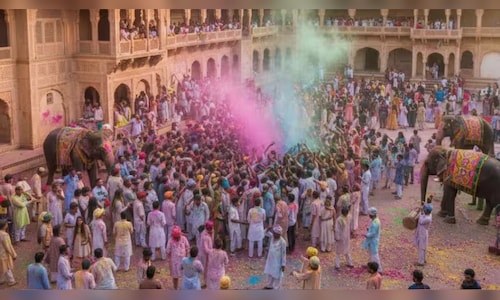
As Holi edges closer, it’s not just gulal that’s flying, travel searches are too. Data from digital travel platforms and hostel networks show that more Indians — and international visitors — are planning their trips around destinations where the festival feels most immersive, rooted and spectacular.
Royal Rajasthan: Jaipur, Udaipur, Pushkar
According to Agoda, accommodation searches for Holi week have surged sharply in Rajasthan’s heritage hubs. Jaipur recorded a 282% increase in searches year-on-year. The Pink City’s palace-led celebrations and festivities around Amer Fort continue to anchor its appeal.
Udaipur saw a 233% rise, with travellers drawn to lakeside celebrations around Lake Pichola and heritage hotels hosting curated Holi events. Pushkar witnessed a 195% jump, thanks to its street gatherings and community-led celebrations around Pushkar lake and its 52 ghats.
International interest is rising too. Agoda data shows Udaipur recorded a 459% increase in searches from across Asia, while Jaipur saw over 191% growth, led by travellers from Malaysia, Thailand, Singapore, Japan and South Korea.
Temple towns: Vrindavan, Mathura, Agra
Spiritual and tradition-led Holi celebrations are firmly on the travel map. Vrindavan registered a 126% rise in travel interest, with visitors keen on flower Holi ceremonies and temple festivities.
Also Read: Japan’s Cherry Blossom Forecast 2026: A traveller’s guide to sakura season
Mathura saw a 109% increase, drawing travellers to celebrations in Lord Krishna’s birthplace. Skyscanner’s Cultural Tourism insights show that 51% of Indians want to experience Lathmar Holi, traditionally celebrated in Barsana and nearby towns.
While many head directly to the epicentre, Skyscanner highlights Agra as a practical base. Proximity to Mathura and Barsana, combined with better connectivity, makes it an attractive option for festival-focused getaways.
Cultural immersion: Varanasi and Shantiniketan
For travellers seeking depth over dazzle, heritage cities are trending. Varanasi has seen a 76% year-on-year rise in searches, according to Skyscanner data, reinforcing its appeal as a city where Holi blends colour with centuries-old tradition.
Shantiniketan, known for Basanta Utsav celebrations rooted in art and music, recorded a 43% increase in travel interest, as per Agoda. Kolkata continues to attract those who prefer Dol Jatra’s more reflective, cultural take on the festival.
Beyond the obvious: Hampi and the Himalayas
Offbeat and experiential settings are also gaining ground. Hampi, with its UNESCO-listed ruins and open temple squares, saw a 128% rise in searches, appealing to culture and history enthusiasts.
Also Read: March travel guide: Holi colours, mild weather draw tourists to 6 Indian destinations
Hostel network Zostel reports a broader experiential shift. The company recorded a 34% year-on-year rise in overall Holi bookings, with a 189% increase in international guest bookings.
In the Himalayas, Sangla saw a 107% surge in bookings, while Kalpa recorded an 85% rise, reflecting a preference for intimate, community-led celebrations over metropolitan crowds. Meanwhile, Jaisalmer registered a 48% rise in overall guests.
Metro energy: Mumbai and key routes
Urban celebrations remain firmly in play. Mumbai features prominently in Skyscanner searches, with beachside gatherings and high-energy parties making it a festival favourite.
Flight searches from Delhi, Mumbai and Bengaluru to key Holi destinations are also seeing strong interest, according to Skyscanner data, indicating robust domestic movement around the long weekend.
A festival driving travel decisions
Skyscanner notes that 76% of Indian travellers have changed travel plans specifically to attend cultural or festival events, and over eight in 10 prioritise destinations for cultural experiences. Holi is increasingly becoming the reason for the trip itself, whether they are palace courtyards in Jaipur, temple squares in Vrindavan, Himalayan valleys in Sangla, or lakeside revelry in Udaipur.
Also Read: Holi airfares surge up to 185% on key routes, Supreme Court flags concern