
Last Updated:
Developing material to AI-generated sermons and Jesus avatar, while artificial intelligence enters the space of worship, a look at the changes and concerns




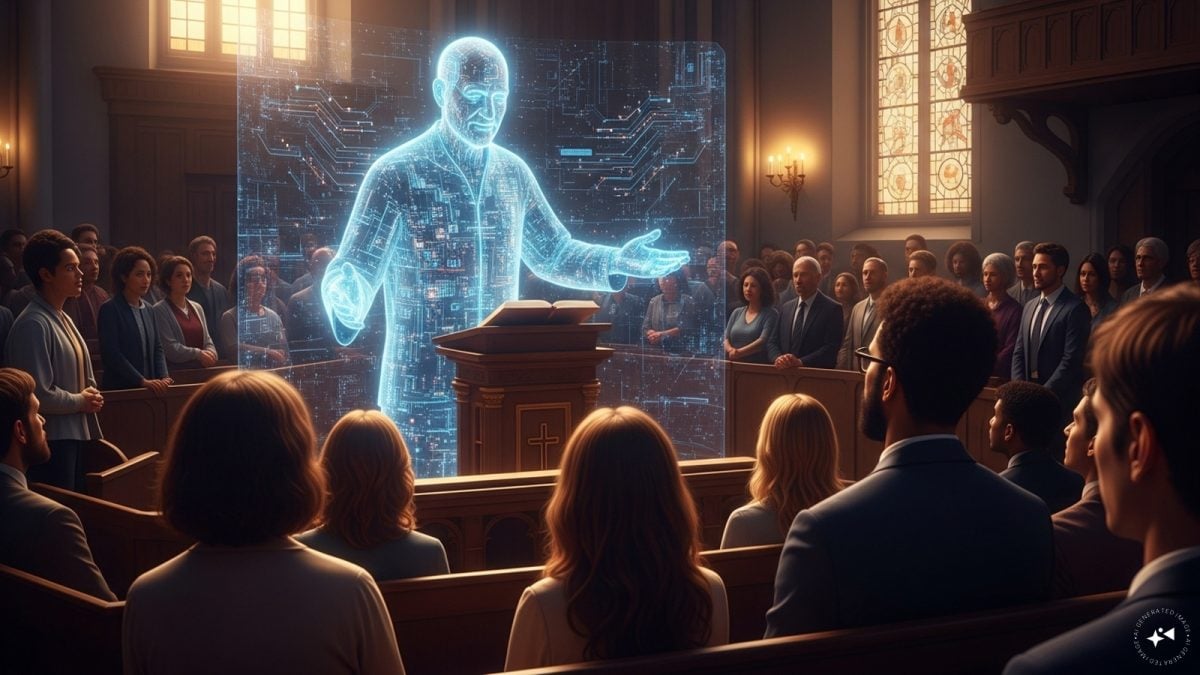
Many raised doubts over the lack of context and accuracy in AI-generated sermons and chatbots. (AI-generated image for representation only)
Not just workplaces, artificial intelligence (AI) has also slowly crept into worship too.
While some use AI to “simulate conversations with Jesus”, others take help from the technology to write sermons, even as academics and religious leaders warn about the risks and potential harm, according to a Reuters report.
Developing material to chatbots
In 2024, Justin Lester, a pastor of Friendship Baptist Church in Vallejo, California, built a custom GPT for his church that uses his sermons to develop small group materials and allows other church leaders to build lessons based on those sermons. “Jesus said we will do greater things,” he told Reuters. “And I think (AI) is part of the greater.”
Meanwhile, Siraj Raval found ‘TalkToHim’, an AI-powered chatbot that simulates conversations with Jesus, as he battled loneliness and existential dread. “I had an experience where I felt listened to by a presence that was divine,” he told Reuters about the app, which he used to seek answers to his spiritual questions, such as how to live with guilt, forgive when it feels impossible, and to act morally.
“It was better than a textbook. It was better than reading the Bible,” Raval, who regularly attends a non-denominational Christian church in Idaho, said.
AI Jesus avatar, AI-generated sermons
Last year, St. Peter’s Chapel in Switzerland installed an AI Jesus avatar in its confessional booth as part of an experimental art installation with a local university. What most surprised Marco Schmid, a theologian at the church, was how seriously people took the experience, with some even thanking the chatbot, Reuters reported.
“Do you say to your computer when you finish, ‘Oh, thank you, computer?’ No,” Schmid told Reuters. “But you see how much people personalized and humanized the system because it was so good.”
Rabbi Josh Fixler of Congregation Emanu El in Houston, 41, during the Jewish High Holidays in 2023, shocked his congregants when he played a recording of himself discussing the impact of AI on humanity — a sermon that he later revealed was AI-generated.
The concerns
“I came away from that sermon with real concerns about both the ethics of the technology and also the hyperfocus on the technology,” Fixler said, adding that some of what the chatbot came up with simply wasn’t true. “It quoted a great Jewish scholar named Maimonides, but as best I can tell, it made up that quote,” he told Reuters.
“I think there is something distinctive about the nature of Christian community, which is about being in person and face to face and being deeply human,” Steven Croft, the bishop of Oxford, said.
Croft’s hesitancy is shared by other religious leaders and academics, many of whom cite a lack of trust in AI’s ability to provide sound religious advice. Beth Singler, an assistant professor in digital religion at the University of Zurich, recalled an instance when a Character.ai “Buddah” erroneously claimed there were five noble truths in Buddhism, instead of four. But it’s not just inaccuracies that she’s concerned about.
“There are questions about the ethics of representations of religious leaders,” Singler said, especially if the chatbot says something profane or, worse, dangerous. “We’ve seen specific examples of people being pushed towards suicide by conversations with chatbots. There (are) some really scary statistics about how often that happens.”
Yaqub Chaudhary, a visiting scholar at the Leverhulme Centre for the Future of Intelligence at the University of Cambridge, also questions whether AI is the best medium to deliver valid and attributable religious information — particularly in the context of his faith, Islam, which considers the Quran the direct and unaltered word of God.
“Is that a true communication of the Islamic meaning if it is produced by an LLM, mixing together whatever it has in its training set?” he told Reuters. “That is a really huge problem in terms of knowing the halal, the haram, the recommended, the permissible, the impermissible, the disliked.”
“I think that the work of religion is not trying to get machines to be more human,” Fixler said. “The work of religion is trying to get us all to be the most human human.”
With Reuters inputs
February 09, 2026, 13:54 IST
Read More