

Last Updated:
The technical feat is seen as a testament to the ‘pioneers at Qualcomm’ and other firms who have embraced the challenge of innovating in India




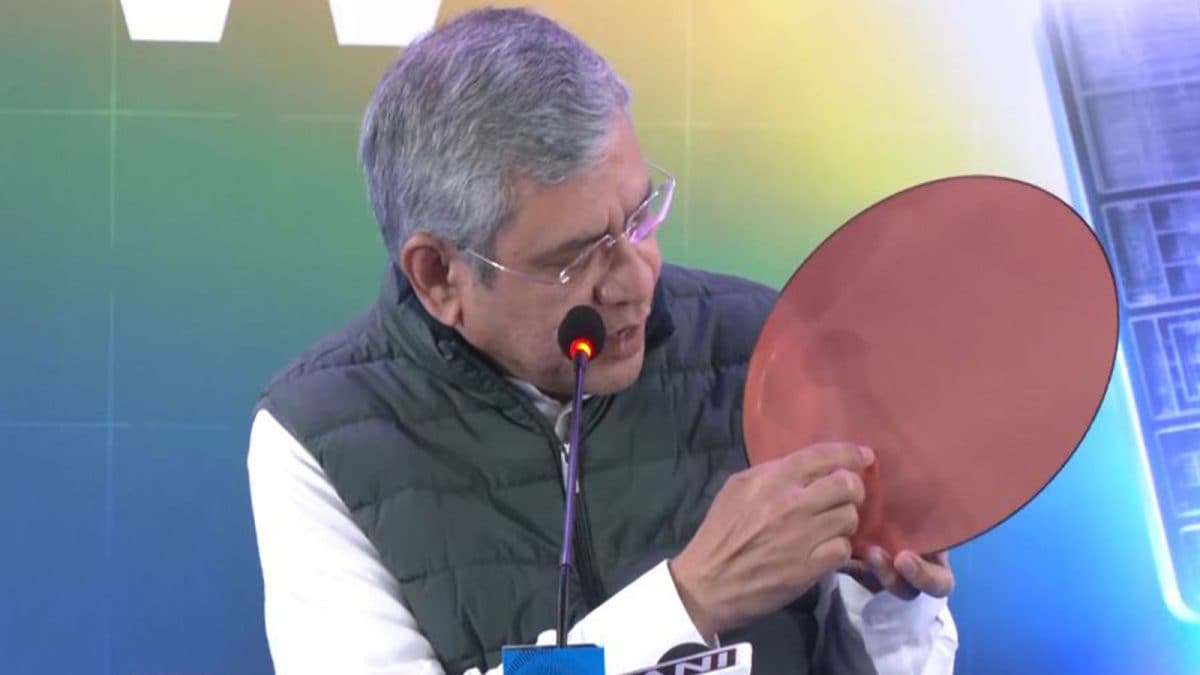
The minister explained that ‘this is the wafer in which each die has about 20 to 30 billion transistors’, a density that allows for the integration of both GPU and CPU capabilities onto a single chip. Image/ANI
In a significant leap for India’s technological sovereignty, Union Minister Ashwini Vaishnaw on Saturday heralded a transformative era for the nation’s semiconductor landscape. Speaking at an event in Bengaluru, the minister unveiled a cutting-edge two-nanometre wafer and chip developed at Qualcomm, a milestone that underscores India’s rapid transition from a service-oriented “back-office” to a premier global hub for end-to-end semiconductor design. This development is not an isolated success but part of a growing momentum, with industry leaders like AMD and Qualcomm now choosing India to execute the entire product lifecycle. As the minister noted, “Gone are those days when most of the development, the back-office development work, was being done here.” Today, the entire process—from customer product definition to final silicon design, tapeout, and validation—is being conducted within the country.
The minister’s demonstration of the silicon wafer provided a rare glimpse into the sheer complexity of modern microelectronics. He explained that “this is the wafer in which each die has about 20 to 30 billion transistors”, a density that allows for the integration of both GPU and CPU capabilities onto a single chip. These high-performance modules are destined to power the next generation of artificial intelligence, serving as the “brains” for everything from desktop AI computers and edge devices like Wi-Fi routers to the sophisticated electronic systems found in automobiles, aeroplanes, and high-speed trains. This technical feat is seen as a testament to the “pioneers at Qualcomm” and other firms who have embraced the challenge of innovating in India.
Central to this progress is the success of the Semicon India 1.0 mission, particularly its focus on human capital. The government originally set an ambitious target of training 85,000 semiconductor professionals over a ten-year period. However, the mission has far exceeded expectations, with 67,000 engineers already trained in just four years. By integrating professional-grade Electronic Design Automation tools into 315 universities and colleges, India has created a unique educational model where “the students are designing chips” and validating final products. This robust talent pipeline caught the attention of global leaders at Davos, who believe that the “1 million talent gap in the semiconductor industry will largely be filled by talent from India”.
Further bolstering this ecosystem are recent budgetary reforms aimed at simplifying the business environment for the IT and hardware industries. By refining the safe harbour clause and streamlining administrative processes, the government has cleared the path for global firms to expand their Indian operations. This groundwork sets the stage for the imminent launch of Semicon 2.0, which will “prioritise design, followed by equipment and materials”. The next phase will also seek to move beyond the current 28-nanometer capability, charting a clear path toward 7-nanometer production. As Minister Vaishnaw noted, this is a multi-decade journey guided by a 20-year strategic roadmap laid out by the Prime Minister to ensure the country continues to develop as a global leader in this vital industry.
February 07, 2026, 18:39 IST
Read More