
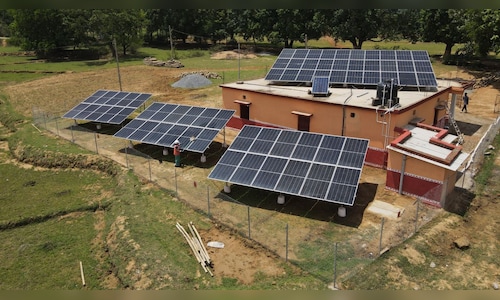
The grid corporations Chief Project Manager Mahesh Das told ANI that the state faces severe limitations in identifying suitable land for conventional ground-mounted solar installations, as most available land is either agriculturally productive or environmentally protected.
“Odisha has a scarcity of land… As you are aware that we have fertile lands which are primarily for cultivation purposes. Around 18 to 30% of land is either forest or used for something else. So, we don’t have a large passage of land for the development of ground-mounted solar power plants,” he said on December 13.
Also read | Infrastructure expansion gave ‘big boost’ to spiritual tourism in country: Shekhawat
To overcome the challenge, the state is planning to install solar panels on floating platforms across reservoirs and other water bodies. Das explained that this approach not only addresses land shortages, but improves operational efficiency.
He noted that Odisha is well endowed with water resources, making it suitable for large-scale floating solar deployment.
“We are blessed with so many water bodies. There are 185 water bodies, including medium, minor, and major water reservoirs are available. We are now intending to develop those water bodies as floating solar surfaces. The concept of floating solar surfaces has been established, and it’s a time-tested technology now,” Das explained.
The water bodies will have floaters upon which solar panels will be mounted, and eventually, power will be tapped down. This generation will have good efficiency because of the proximity to water, you don’t have to clean it.”
According to Das, the natural cooling effect of water helps solar panels operate more efficiently while also reducing maintenance requirements such as frequent cleaning.
GRIDCO has already taken concrete steps towards this transition. A tender for a floating solar project of around 1,000 megawatts has been issued for the Rengali reservoir. Further developments are planned at Upper Indravati and Hirakud reservoirs.
“The second point is that efficiency is higher due to the panels’ cooling effect. We have already floated a tender for the Rengali reservoir, around 1000 megawatts, for captive use. The next step will be 225 megawatt in Upper Indravati and 1.5 gigawatt in Hirakud. We will be looking at all these water bodies in a lump sum and holistic way.” Das added.
Emphasising the environmental imperative behind the initiative, Das highlighted the need to expand green energy capacity to curb carbon emissions, particularly in an industrially intensive state like Odisha.
“We have to have a reduction in carbon dioxide, which we cannot do unless we develop our ecosystem for green energy. We are producing at least 30% of steel in Odisha, but at the same time we are producing carbon dioxide,” he said.
(Edited by : Jerome Anthony)