
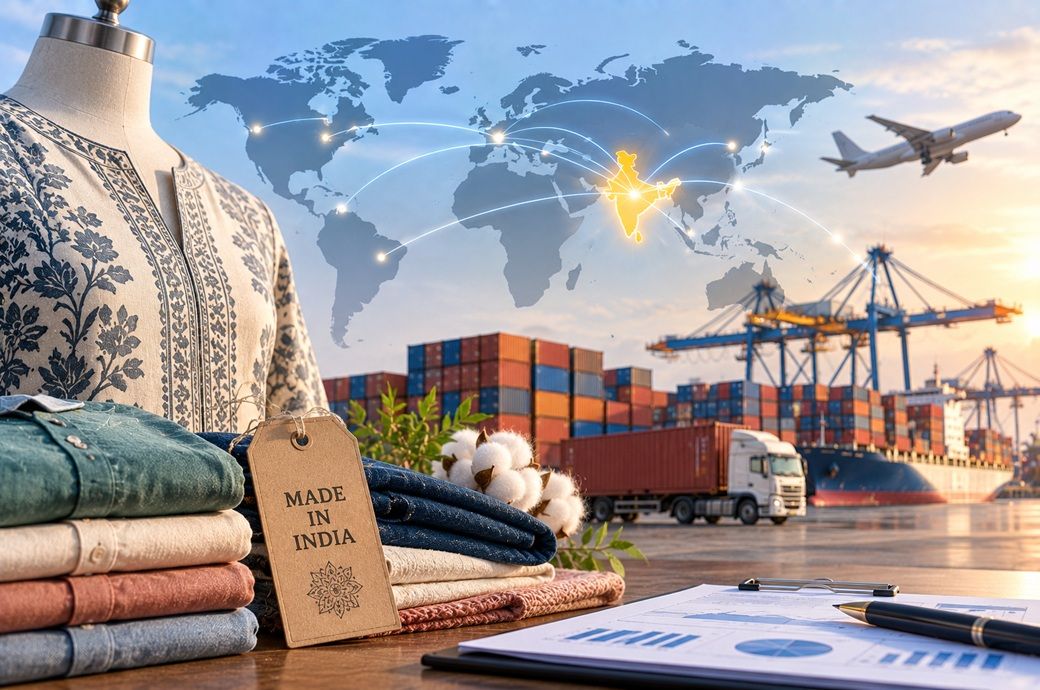
The report titled ‘Tailwinds Converging for a Multi-Year Upcycle’ said India’s apparel export opportunity is being supported by the India-UK CETA, the conclusion of India-EU free trade agreement talks, and policy initiatives such as the Production Linked Incentive (PLI) scheme and PM MITRA. However, it cautioned that India’s ability to capture a larger share of global apparel trade will depend on manufacturers scaling up capacity, improving productivity and strengthening vertical integration.
India accounted for about 4 per cent of global textile and apparel exports in 2025, with exports of around $37 billion in FY26. Apparel accounted for about 44 per cent of India’s textile and apparel exports. PL Research noted that India’s apparel exports have remained relatively rangebound in recent years, while fragmented manufacturing capacity, longer lead times and limited man-made fibre (MMF) capabilities continue to constrain competitiveness.
India held about 3 per cent of global apparel exports in 2025, while China’s share fell to 27.3 per cent from 36.9 per cent in 2010, PL Capital said.
Bangladesh and Vietnam have captured more of the shift, lifting their combined share to over 13 per cent.
Trade access, China+1 sourcing and policy support could favour large, integrated Indian garment exporters.
The global sourcing landscape is meanwhile shifting as China’s share of global apparel exports declined from nearly 37 per cent in 2010 to about 27 per cent in 2025. PL Research estimated that this change has released roughly $50-60 billion of apparel sourcing volume into the global market, with Bangladesh and Vietnam among the major beneficiaries.
The report noted that global apparel brands are increasingly consolidating sourcing among fewer, larger suppliers capable of handling sizeable orders, operating across multiple countries and meeting higher environmental, social and governance (ESG) and traceability requirements. Scale, integrated manufacturing, speed to market and compliance are therefore becoming increasingly important in supplier selection.
For Indian manufacturers, PL Research identified capacity expansion, vertical integration, greater exposure to MMF and technical textiles, multi-country manufacturing footprints and stronger ESG compliance as key areas for improvement. India’s synthetic garments accounted for about 32 per cent of garment exports in 2025, up from 22 per cent in FY20, with exports growing at a 9 per cent CAGR over FY20-25.
Labour productivity remains another challenge. The report estimated that Indian workers produce about 8-10 T-shirts per hour on average, compared with 12-15 in Bangladesh and Vietnam. It also highlighted slower adoption of technologies such as computer-aided design, AI-based quality inspection and factory automation among India’s smaller and mid-sized garment manufacturers.
Sustainability and traceability are also becoming increasingly important as European regulations require greater product-level information and environmental compliance. PL Research said these requirements are shifting sustainability compliance from a competitive differentiator toward a condition for market access for export-oriented manufacturers.
The report highlighted Indian companies including Pearl Global Industries, Gokaldas Exports and KPR Mill as listed manufacturers positioned to benefit from the changing sourcing environment, citing their respective multi-country manufacturing, capacity expansion and vertical-integration strategies.
PL Research noted that the opportunity created by global supply-chain diversification will not automatically translate into higher Indian market share. It identified scale as a key gap, noting that the world’s largest garment manufacturers operate capacities of roughly 200-550 million pieces annually, while KPR Mill is the only listed Indian player with more than 200 million pieces of annual garment capacity.
Fibre2Fashion News Desk (CG)