
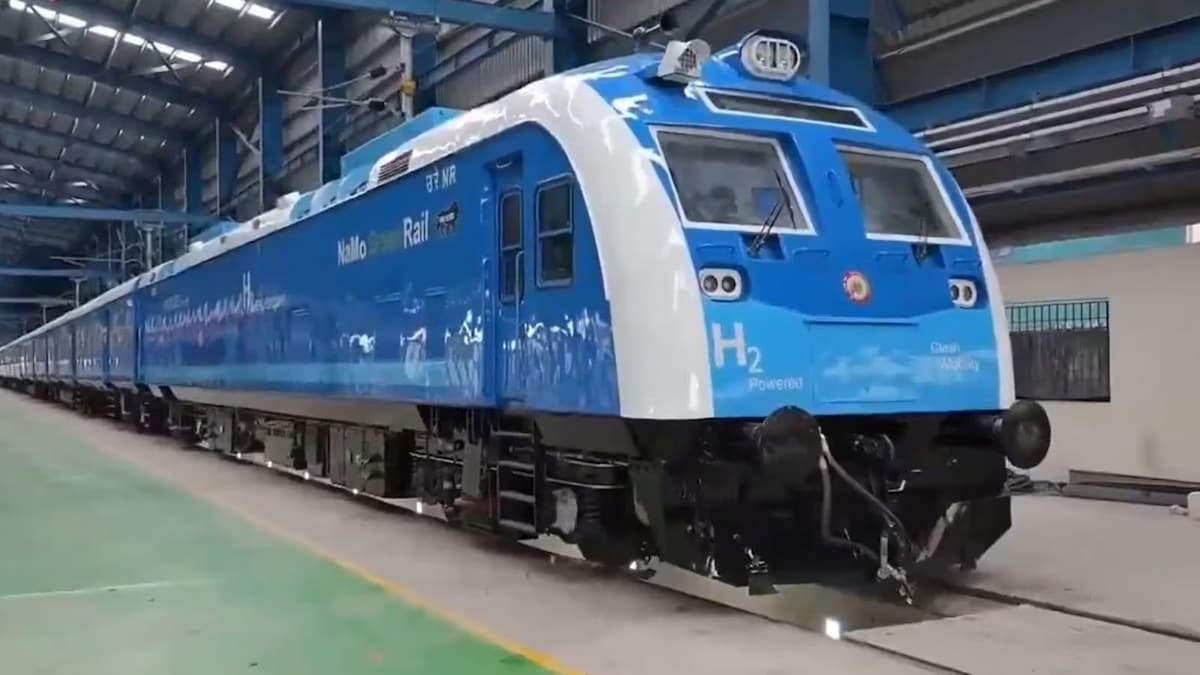
Prime Minister Narendra Modi is expected to flag off the service from Haryana’s Jind railway station on July 17. “As of now, we have received confirmation from the PMO that Prime Minister Modi will flag off the hydrogen train from Jind on July 17,” a senior railway official was quoted as saying by PTI.
With the launch, India will join countries such as Germany, Japan, China and the United States that are exploring hydrogen-powered rail technology for cleaner transportation.
Route and Operations
The hydrogen-powered train will operate on the Jind-Sonipat section under Northern Railway, covering an 89-km one-way journey. The service will run two round trips daily, covering a total distance of 356 km each day.
How the Train Works
Unlike diesel trains, the hydrogen train generates electricity through hydrogen fuel cells, which combine hydrogen and oxygen to produce power. The process emits only water vapour, making it an environment-friendly alternative that helps reduce carbon emissions.
Features and Speed
The 10-coach train has been developed by retrofitting a Diesel Electric Multiple Unit (DEMU) and includes two driving power cars and eight passenger coaches. It offers 682 seats and can accommodate around 2,600 passengers. Although designed to run at a maximum speed of 110 kmph, the train will initially operate at 75 kmph on the Jind-Sonipat route.
“At maximum passenger load and operating conditions, it will consume about 300 kg of hydrogen per day. The train is designed to safely reach a maximum speed of 110 kmph; however, its operational speed on the Jind-Sonipat route will be 75 kmph,” as per the railway officials.
Built in India
The train was built by the Integral Coach Factory (ICF), Chennai, while Hyderabad-based Medha Servo Drives handled system integration. The hydrogen fuel-cell stacks have been supplied by Canada’s Ballard Power Systems.
Hydrogen Infrastructure
To support the project, Indian Railways has established a dedicated hydrogen production, storage and refuelling facility at Jind. The facility can produce 420-430 kg of hydrogen per day and store up to 3,000 kg.
The train is also equipped with hydrogen leak and flame detection systems, and the facility has received safety clearance from the Petroleum and Explosives Safety Organisation (PESO).
Also Read: Explained: Why countries are betting big on hydrogen fuel
(Edited by : Asmita Pant)