
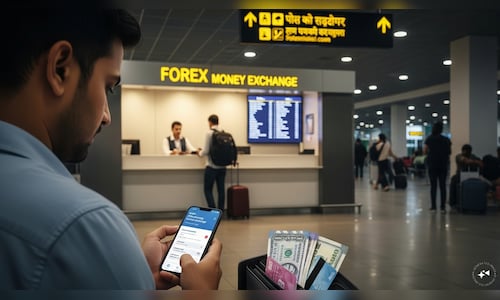
Airport forex: Convenience, but at a premium
Airport forex counters are designed for last-minute or emergency currency needs, offering immediate access to cash without prior planning. However, experts consistently flag this as the most expensive channel for foreign exchange.
According to Amit Talwar, CEO of Niyo Forex, a digital financial service in India, airport exchanges can cost travellers around 2–4% more than pre-arranged forex options, largely due to convenience-driven pricing.
Similarly, Pavan Kavad, Managing Director of Prithvi Exchange, an RBI-authorised foreign exchange and outward remittance company, notes that markups can range from 3–8% and may go as high as 10–15% in certain airports or less competitive locations once exchange spreads and service charges are included.
Experts say airport forex is best viewed as a backup option, not a planned method for purchasing foreign currency.
Pre-booked forex and cards: Planning-led savings
In contrast, pre-booked forex, whether currency notes or forex cards loaded before departure, allows travellers to lock in exchange rates in advance and avoid last-minute pricing premiums.
Deepesh Varma, Chief Business Officer – Foreign Exchange at Thomas Cook (India) Limited, an integrated travel and travel-related financial services company, says prepaid forex cards are among the most cost-effective tools for overseas spending because they help travellers manage currency volatility and plan expenses in advance.
Industry experts broadly agree that advance booking typically offers more competitive rates compared with airport purchases, particularly for planned trips and higher forex requirements.
Digital-first booking and pricing transparency
Gagan Malhotra, Chief Operating Officer at BookMyForex, an online foreign exchange marketplace and money transfer platform, backed by MakeMyTrip, notes that airport forex pricing reflects a lack of choice at the point of travel, where travellers are often forced to accept prevailing counter rates.
He adds that airport counters can charge 6–10% above interbank rates, while online forex booking platforms allow access to live interbank rates with transparent pricing and no hidden markups.
He also highlights that advance booking enables additional benefits such as doorstep delivery and prepaid forex cards activated before travel, which are not available at airport counters.
Hidden costs beyond the exchange rate
Experts highlight that the exchange rate alone does not capture the full cost of spending abroad, as several additional charges can apply depending on the payment method.
Amit Talwar of Niyo Forex points out that Dynamic Currency Conversion (DCC), where transactions abroad are converted into Indian rupees, often results in poorer exchange rates.
He also notes that credit card forex markups of around 2–4% per transaction, along with ATM withdrawal fees, can significantly increase overall travel costs.
Malhotra similarly highlights that ATM usage and card payments can involve multiple stacked charges, including foreign transaction fees, ATM operator charges, and conversion spreads, all of which add to the final cost if not planned in advance.
How travellers should manage forex
Talwar asks travellers to carry enough cash to cover the first 24–48 hours, including transport, meals, and immediate expenses, while using cards for most transactions abroad.
Kavad similarly recommends planning ahead and limiting cash usage to small or unavoidable expenses, rather than relying on airport exchanges for significant amounts.
When airport forex still makes sense
Despite higher costs, airport forex counters continue to serve a limited but practical role.
Experts agree they are most useful in cases of emergency travel, last-minute departures, or when travellers require a small amount of local currency upon arrival. However, they are not considered suitable for planned or large-value transactions.
ALSO READ | From hotel memberships to luxury perks: Which super-premium credit card features suit you